
Technology
JEPA vs LLMs: The Architecture War That Will Define the Next Decade of AI
22 APR2026
10 MINRead
---
Views Sterlites
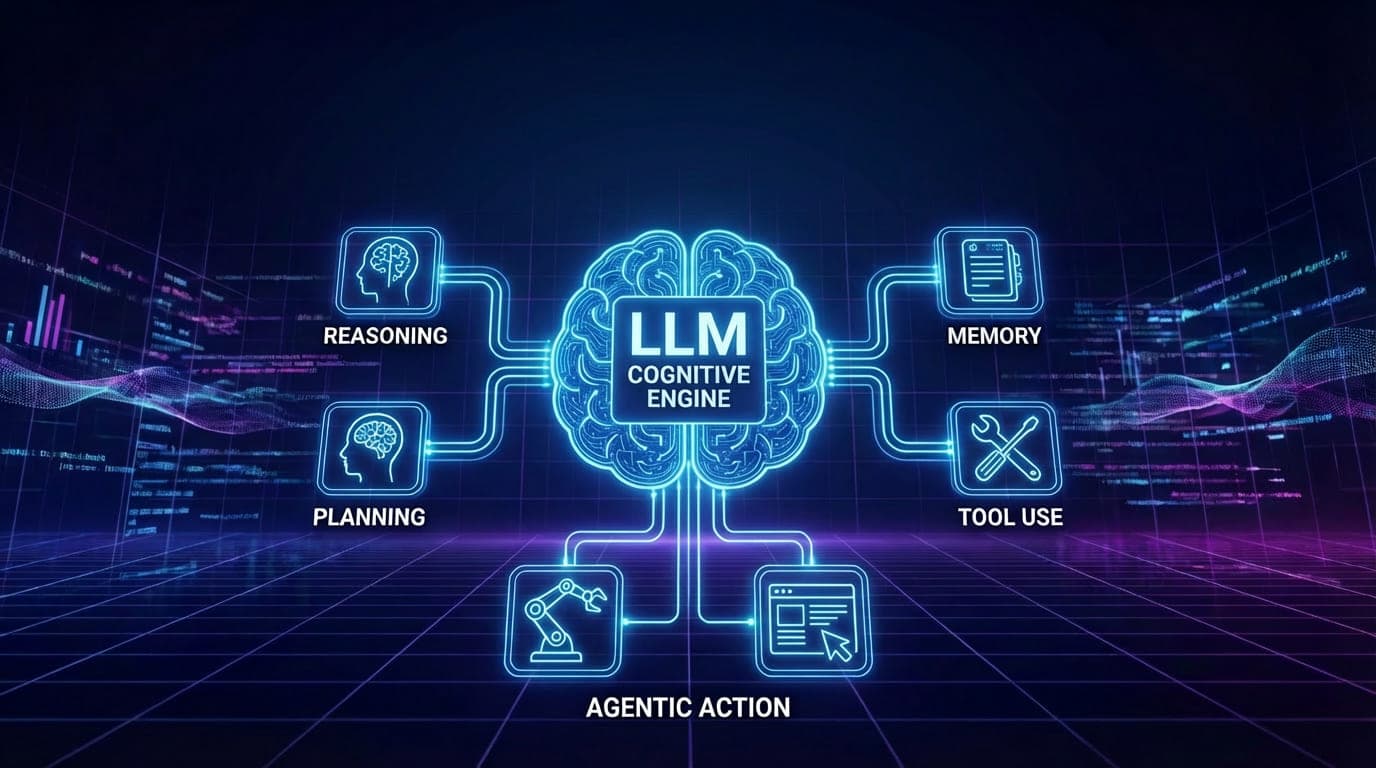
The transition from static, reactive artificial intelligence to autonomous, goal-oriented agentic systems represents a fundamental shift in the computational paradigm of the twenty-first century. This evolution is underpinned by the unprecedented success of Large Language Models (LLMs), which have transitioned from being sophisticated next-token predictors to becoming the central cognitive engines for complex, multi-step problem solving. At the heart of this “agentic turn” is the integration of reasoning, memory, planning, and tool use, enabling AI to transcend the boundaries of the chat window and interact purposefully with the digital and physical worlds.
The current era of generative intelligence is rooted in the “Attention Is All You Need” breakthrough of 2017, which introduced the Transformer architecture. Prior to this innovation, sequence modeling relied on Recurrent Neural Networks (RNNs) and Long Short-Term Memory (LSTM) units, which processed data sequentially. This sequential nature created a bottleneck, as the gradient for long sequences often vanished or exploded, making it difficult for models to maintain context over extended passages.
The Transformer resolved these limitations through the self-attention mechanism, which enables the model to process all tokens in a sequence simultaneously. By calculating the relationship between every token in an input, the model assigns weight to the most relevant information, regardless of its distance in the text. This is achieved through three learned vectors: the Query (Q), the Key (K), and the Value (V). The attention score is derived from the dot product of the Query and the Key, which is then scaled and passed through a softmax function to create a weighted distribution applied to the Value. The mathematical representation of this operation is defined as:
To refine this process, modern Transformers utilize multi-head attention (MHA). Instead of a single attention operation, the model performs multiple parallel attention “heads,” each projecting the Q, K, and V into different representation subspaces. This allows the model to simultaneously attend to syntactic structures (e.g., which subject a verb refers to) and semantic nuances (e.g., the tone of a sentence).
The parallel nature of Transformers is perfectly suited for Graphics Processing Units (GPUs) and Tensor Processing Units (TPUs), which can execute the vast matrix multiplications required for training and inference at scale.
The predictable improvement of LLMs as they grow in size is described by scaling laws. Research indicates that model performance, measured by loss in predicting the next token, improves as a power-law function of parameters (N), dataset size (D), and total training compute (C). This observation fueled the “scaling race,” leading to models like GPT-3 and beyond, which demonstrated emergent capabilities such as few-shot and zero-shot learning.
The training process is typically divided into two major phases: pre-training and post-training alignment. Pre-training involves self-supervised learning on massive, unlabeled corpora of text, code, and multimodal data. During this stage, the model internalizes the statistical structures of language, world knowledge, and reasoning patterns. Techniques like Byte Pair Encoding (BPE) are used for advanced tokenization, allowing the model to represent language efficiently by breaking it down into sub-word units rather than individual characters or whole words.
As models reach the limits of pre-training data, attention has shifted to test-time scaling. This concept posits that an LLM can produce better results if it is given more “time to think” during inference through techniques like best-of-N sampling or sequential revision.
While pre-training creates a knowledgeable model, it does not ensure that the model is aligned with human values or intentions. This is achieved through Reinforcement Learning from Human Feedback (RLHF). In RLHF, humans rank different model outputs, and a separate reward model is trained to predict these rankings. The LLM is then fine-tuned using Proximal Policy Optimization (PPO) to maximize the reward while maintaining a constraint to prevent the model from deviating too far from its original pre-trained distribution.
However, RLHF is computationally intensive and complex to implement due to the need for multiple models. Direct Preference Optimization (DPO) has emerged as a promising RL-free alternative. DPO mathematically derives a closed-form solution that allows the model to be aligned directly on preference pairs (chosen vs. rejected responses) without an explicit reward model or reinforcement learning algorithm.
The goal of these alignment stages is to ensure the model adheres to the “HHH” criteria: Helpful, Honest, and Harmless. Research indicates that aligned models are significantly more reliable for enterprise use, though they may suffer from an “alignment tax”, a slight decrease in raw capability on certain benchmarks in exchange for improved safety and steerability.
Large Language Models are fundamentally reactive; they process an input and generate an output in a single turn. Agentic AI, however, introduces the concept of agency, the ability to independently assess, plan, and act to achieve a goal. While a standard chatbot waits for a prompt, an agentic system can set its own sub-goals, iterate on tasks, and adapt to feedback from the environment.
The architectural distinction between these systems is profound. Standard LLM applications are often stateless and transactional, meaning each call starts fresh. Agentic systems are stateful; they maintain a memory of past actions and observations, which informs their next move. This statefulness is what enables “long-horizon” tasks, objectives that require hundreds or thousands of steps to complete.
Agency does not necessarily require the AI to have its own consciousness or desires. Instead, it is a functional property where the system is given an intention (e.g., “Organize a global conference”) and translates that into a complex series of instructions and actions. Experts categorize this shift as moving from “automating a task” to “automating an outcome”.
An effective agentic system is structured around a “cognitive core,” typically powered by a reasoning-capable LLM that acts as the system’s brain. This core is supported by three other essential pillars: Planning, Memory, and Tool Use.
Agents must be able to decompose a high-level goal into manageable steps. Several reasoning patterns have been identified to facilitate this:
Memory allows agents to learn from experience and maintain context over time. Modern architectures use a hierarchy of memory:
The third pillar, Tool Use, transforms the agent from a passive thinker into an active participant. Through function calling and API integration, agents can search the web, query databases, execute code, and interact with other software systems. This is increasingly standardized through protocols like the Model Context Protocol (MCP), which provides a universal interface for connecting agents to data sources.
A significant barrier to the widespread adoption of agentic AI was the “N x M” integration problem, the requirement for every model to build a custom connector for every possible data source or tool. The Model Context Protocol (MCP), introduced by Anthropic in late 2024, has become the de-facto standard for addressing this fragmentation.
MCP acts as a universal translator between AI agents and external systems. It allows a developer to implement an MCP server once, which then makes that tool or data source accessible to any model (Claude, GPT, Gemini) that supports the protocol. This “plug-and-play” modularity accelerates the development of context-aware agents.
Beyond simple connectivity, MCP enables “Code Mode” or code execution with tools. Instead of the model requesting a tool and having the raw data flow through its context window, the agent can write code that runs locally within the MCP environment. This code can filter 100,000 tokens of raw data into a 200-token summary, drastically reducing costs and preventing sensitive information (like PII) from ever reaching the model’s cloud-based inference server.
For complex enterprise workflows, a single agent is often insufficient. Multi-agent systems involve several specialized agents collaborating on a shared goal. This modular approach improves scalability and maintainability, as individual agents can be optimized for specific domains like research, coding, or legal analysis.
Orchestration patterns for these systems vary based on the level of control required:
Frameworks like Microsoft’s AutoGen and CrewAI have been developed to manage these interactions. AutoGen treats multi-agent workflows as conversations, where agents “talk” to each other to reach a solution. CrewAI focuses on role-based teams, where each agent is given a specific persona and set of tools to execute a defined process. Meanwhile, LangGraph provides a more deterministic, graph-based approach for developers who need to define explicit state transitions and recovery paths in complex branching logic.
Research into hierarchical systems like AgentOrchestra has demonstrated that localized tool ownership, where each sub-agent manages its own specific set of tools, prevents the context fragmentation that occurs when a single orchestrator tries to manage everything.
The success of an AI agent is fundamentally different from a single-turn LLM response. Agents operate over time, manage state, and interact with tools, which introduces new failure modes. Traditional benchmarks like MMLU or HumanEval are limited because they don’t capture the agent’s ability to navigate environments or recover from errors.
New “agent-first” benchmarks have emerged to fill this gap:
Reliability remains the primary hurdle for production deployments. While an agent might have a high “Pass^1” score (success on the first try), its consistency across multiple runs (Pass^k) is often lower. For enterprises, this means agents are currently most effective in “human-in-the-loop” configurations, acting as deep research assistants or data analysts whose work is reviewed by experts before final action is taken.
Autonomous agents present unique risks compared to static models. The ability to execute actions means that a misaligned or compromised agent could exfiltrate data, perform unauthorized transactions, or bypass security protocols through prompt injection. Research identifies three major categories of agentic risk:
Governance frameworks must be integrated into the AI project lifecycle. This includes establishing committees, addressing ethical principles, and integrating guardrails into the orchestration layer. In regulated industries like healthcare and finance, auditable trails, where every tool call and model reasoning trace is logged, are non-negotiable for compliance.
The rapid evolution of these technologies has necessitated new forms of education. Universities and industry leaders have launched specialized masterclasses and certification programs focused on the fundamentals of LLMs and Agentic AI.
The high computational cost of running agentic workflows has driven significant research into inference optimization. FlashAttention has become a silent standard, improving Transformer performance on GPUs by 2-4x through I/O-aware computation. PagedAttention, developed as part of the vLLM project, manages memory for long-context generation by splitting the KV cache into pages, similar to operating system memory management.
Moreover, the emergence of sparse attention mechanisms, such as those used in Mixture-of-Experts (MoE) models like Mixtral, allows models to activate only a subset of their parameters for any given token. This enables the deployment of trillion-parameter models that remain economically viable for the iterative calls required by agentic loops.
The “Kinetics” scaling law suggests that for reasoning-intensive tasks, it is more effective to use larger models with fewer samples than many samples from tiny models, as the memory access costs for long-sequence generation become the dominant bottleneck.
In a business context, the shift to agentic AI is transforming organizational productivity. Organizations are moving away from reactive chatbots toward “digital teammates” that can manage entire lifecycles.
The “Compound AI System” philosophy emphasizes that the future of AI isn’t just about bigger models, but smarter, more integrated systems. By combining multiple specialized tools, retrievers, code executors, and various LLMs, enterprises can achieve results that exceed the performance of any single monolithic model.
The next frontier for agentic AI is self-evolution and long-horizon strategic consistency. Systems like MUSE and HexMachina are demonstrating that agents can learn from their own “trajectories”, the history of their actions and outcomes, to refine their strategies over time. This continuous learning allows an agent to evolve beyond its static pre-trained parameters, making it more effective as it accumulates experience in a specific environment.
Furthermore, the integration of Process Reward Models (PRMs) allows agents to receive feedback on every intermediate reasoning step, rather than just the final outcome. This “dense supervision” is critical for complex tasks like recommendation systems or strategic gaming, where the correct final answer depends on a long chain of valid intermediate decisions.
For organizations and practitioners looking to implement agentic systems, a structured approach is recommended:
The transition to agentic AI is not merely a technical upgrade; it is a shift in how humans and machines collaborate. By understanding the fundamentals of Transformer architectures, the nuances of cognitive design patterns, and the rigors of agent evaluation, we can build systems that are not just intelligent, but capable of meaningful, autonomous action in the service of human goals.
Thinking about Technology? Our team has helped 100+ companies turn AI insight into production reality.
Book a highly tactical 30-minute strategy session. We apply the engineering rigor developed with McKinsey, DHL, and Walmart to accelerate AI for startups and enterprises alike. Let's bypass the hype, evaluate your specific use case, and map a concrete path to production.
Establish your authority. Amplify these insights with your professional network.
Hand-picked insights to expand your understanding of the evolving AI landscape.