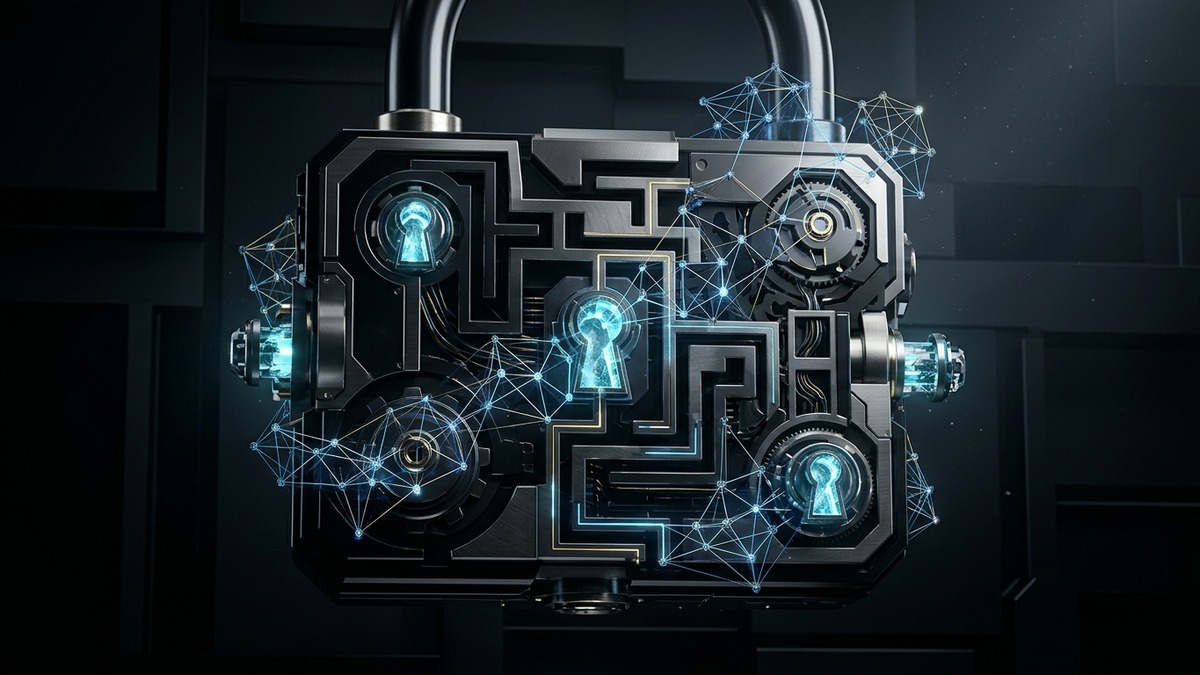
The Asymmetry of Discovery: Why Autonomous AI Security Changes Everything
Autonomous AI security frameworks weaponize computational asymmetry by automating the trial-and-error discovery loop across digital infrastructure. Because checking an exploit takes milliseconds while exhaustive search requires exponential work, multi-agent swarms operating dual-graph architectures compress weeks of manual penetration testing into minutes. Sterlites helps enterprise leadership counter machine-speed attack surfaces by engineering deterministic verification harnesses, out-of-band proxy recording, and automated Zero Trust containment gates.
The Paradox That Runs Modern Reality: Verification vs. Discovery
Checking whether a computational solution works requires negligible fractions of a second, whereas discovering that solution within an unmapped, high-dimensional search space demands exponential time and resources.
Imagine standing inside an unfamiliar 100-room mansion in pitch-black darkness. Somewhere on a carpet in one of those rooms, a single brass key lies on the floor. To find it, you have to crawl on your hands and knees, feeling every square inch of floorboard in the dark. You might search for hours, days, or even a lifetime, bumping into walls and retracing your steps across the cold hardwood.
Now imagine a second scenario: someone walks up to you in the dark, hands you a brass key, and leads you directly to a locked door. You slide the key into the keyhole. It turns smoothly with an instantaneous mechanical click.
That sudden click reveals a profound structural mystery: verifying that a key works takes less than a second, while searching for that exact key in the dark can take forever.
This physical sensation is not a quirk of human geometry. It is the fundamental computational complexity tension that governs our digital world. Checking a correctness proof is blindingly fast, but searching through an ocean of possibilities to construct that proof is unimaginably hard.
The Two Universes: Why Civilization Depends on Hardness
To understand why this asymmetry underpins our entire lives, consider two hypothetical computational realities:
- Universe Alpha (Instant Search): A world where finding solutions to massive combinatorial search problems is just as instant as checking them. In this universe, medical researchers instantly solve protein-folding configurations to cure terminal diseases overnight. However, digital infrastructure completely collapses. Every banking password, encrypted conversation, and cryptographic lock across the planet unlocks instantly, because guessing a 256-bit secret key takes no more effort than verifying one.
- Universe Beta (Our Reality): A world bound by computational asymmetry. Here, creating a hard problem is trivial, but solving it requires sifting through an astronomical universe of combinations. Modern banking, cloud infrastructure, and software security exist solely because our digital world lives in Universe Beta. We rely entirely on the vast time gap between creating a puzzle and brute-forcing its solution.
Defenders have historically relied on a quiet, invisible luxury: the friction of time. Modern digital defense was never built on the assumption that attackers were blind. It was built on the math that searching every hallway in the dark takes too long for an adversary to execute systematically.
Why Scientists Hit a Wall: Theory Collides with Machine Speed
For over 50 years, theoretical computer scientists and mathematicians have attempted to formally bridge this computational gap. They sought to map the ultimate theoretical boundaries between fast verification and slow search, a quest famously encapsulated by the P versus NP problem.
Recently, that blackboard theory crashed headfirst into engineering reality. The sudden rise of multi-agent AI security frameworks, such as ARTEX and XBOW, has taken theoretical search problems out of academic journals and turned them into a high-stakes, real-world battleground operating at machine speed. Autonomous AI swarms can now automate the exhaustive search loop, exploring software vulnerability landscapes at the speed of LLM inference and fundamentally reshaping asymmetry of discovery in multi-agent systems.
Five Doors of Understanding: From Physical Playground to Pure Complexity Theory
Computational hardness is not an abstract academic curiosity; it is a physical hierarchy of combinatorial friction that scales exponentially across five intuitive conceptual tiers.
Door 1: The Jigsaw Puzzle (For a 10-Year-Old)
Imagine opening a box containing a 1,000-piece jigsaw puzzle. You dump the pieces onto a table in a messy pile of blue sky, green grass, and tiny brown cardboard tabs.
To solve it, you spend an entire weekend sitting on the rug. You carefully flip pieces over, compare tiny printed edges, try matching shapes, and make hundreds of wrong guesses before two pieces snap together. It takes two full days of tedious trial and error to assemble the complete image.
When you finish, your friend walks into the room, looks down at the table, and sees a complete picture of a lighthouse. It takes your friend exactly two seconds to look at it and say, “Every piece fits perfectly. You did it!”
Building the puzzle required an entire weekend of searching. Verifying the completed puzzle took two seconds. The puzzle itself did not change, but finding the arrangement was thousands of times harder than checking the result.
Door 2: The Bicycle Lock and Combinatorial Explosion (For a High Schooler)
Consider a standard bicycle lock with 3 spinning dials, numbered 0 through 9. To open it without knowing the code, you must try combinations one by one: 0-0-0, 0-0-1, 0-0-2, all the way to 9-9-9. That represents 1,000 total combinations. If you test one code per second, you can crack the lock in less than 20 minutes, roughly the length of a school lunch break.
Now, imagine we construct a mega-lock with 20 dials. Adding 17 extra dials does not make the lock 17 times harder; it multiplies the possibilities exponentially. A 20-dial lock has 100 quintillion possible combinations (a 1 followed by 20 zeros).
The Exponential Scaling of Combinatorial Lock Mechanisms
Combinatorial search spaces scale exponentially with problem dimensionality, proving why linear human brute force fails against large cryptographic boundaries.
If you lined up a supercomputer capable of testing one billion combinations every single second, it would still take thousands of years to try every code. You are essentially trying to out-guess the heat death of the universe while sitting in traffic. The lock maker easily created a puzzle by snapping a single code shut. The lock breaker faces a search space so vast that physical time runs out.
Door 3: The Delivery Driver’s Nightmare (For a Programmer)
In routine software engineering, some algorithms complete in deterministic, predictable steps. If you ask a computer to sort 1,000 song titles alphabetically, it completes the task instantaneously. The computer compares titles and places them in order using a predictable routine.
Now, consider a different task: The Delivery Driver Problem (the classic Traveling Salesperson Problem). A delivery truck must visit 50 specific addresses scattered across a congested city, drop off packages, and return home. What is the absolute shortest, most fuel-efficient route that connects all 50 stops?
Unlike sorting songs, finding the absolute best delivery route requires evaluating an astronomical number of route combinations: (roughly 30 million trillion trillion trillion trillion possibilities). Finding the optimal path requires traversing an exponential combinatorial space.
Busting the #1 Misconception About AI
Many people assume that modern AI agents, such as the multi-agent engines powering ARTEX or XBOW, possess magical thinking powers that instantly calculate answers to massive optimization problems.
They do not. AI is not magic; it is an insanely fast, tireless assistant that automates the scientific method.
Modern AI agents do not bypass mathematical reality or discover shortcut polynomial algorithms for NP-hard problems. Instead, systems like ARTEX operate closed-loop decision engines that cycle through a disciplined feedback loop:
An AI agent does not magically know a target’s secret vulnerabilities in advance. Instead, it automates the tedious, multi-step trial-and-error workflows that human security experts used to type manually into terminal windows, orchestrating multi-agent execution loops at scale.
The Worker Retirement Insight: Preventing Memory Degradation
To execute this loop without degrading, modern platforms like XBOW and ARTEX employ short-lived worker agents: hyper-focused digital processes operating on a tight 60-second lifecycle. Why retire workers after a single task?
Language models suffer from agent context bloat and memory degradation when forced to carry long conversational histories. When a single model instance processes dozens of sequential commands, error accumulation and hallucination rates compound rapidly.
Here is what most teams get wrong when architecting enterprise agent runtimes: they attempt to keep a single agent session alive for hours. Long-running LLM contexts suffer from catastrophic attention dilution and confirmation bias. Retiring workers after atomic tasks eliminates memory pollution entirely.
By assigning a single worker one isolated intent (such as probing a specific API parameter), allowing it to execute real tools, write back structured facts, and immediately terminating it, the orchestrator keeps search chains crisp, unbiased, and computationally lean.
Thinking about AI Security? Our team has helped 100+ companies turn AI insight into production reality.
Door 4: The Cryptographic Fortress (For Systems Engineers)
Modern software architecture, digital banking, API security, and TLS encryption depend entirely on computational hardness. If finding secrets were as fast as verifying them, digital commerce would terminate instantly.
In production environments, modern autonomous assessment systems survive because engineers design mechanisms that balance exhaustive exploration with real-world operational constraints.
Frameworks like ARTEX manage the state space of an assessment using a dual-graph architecture, separating state memory into two distinct structures linked by explicit relational anchors:
- Asset Graph (Globally Shared): Stores the static ground truth of target infrastructure (
root_domain -> subdomain -> service -> app -> endpoint). It handles domain hierarchy, infrastructure deduplication, and cross-task asset memory. - Exploration Graph (Per-Task Lineage): Tracks active task reasoning, linking nodes (
goal,intent,fact,finding,hint) via directional edges (spawns,derived_from,yields,proves). - Anchors: Map task intents directly to target assets, producing real-time test coverage ledgers and preventing redundant scanning of discovered interfaces.
To keep autonomous agents from spinning into infinite recursion or taking down production servers, production engines enforce strict operational bounds:
- Bounded Budgets: Parameters such as
ARTEX_TASK_BUDGET_TOKENSandARTEX_INTENT_BUDGET_TOKENScap total token spending. When token budgets run low, the planner triggers a forced wrap-up. - Target Noise Governors: Rate-pacing rules (with noise profiles set to quiet at 2 requests per second, balanced at 5 requests per second, or aggressive at 20 requests per second) control request bursting, enforce per-host in-flight limits, handle HTTP 429 backoffs, and apply low-and-slow guidance to underlying tools (nmap, nuclei, ffuf, sqlmap).
- Verifiable Proofs via Recording Proxies: ARTEX routes worker traffic through a local recording Man-in-the-Middle (MITM) proxy (defaulting to port 8788) with a generated CA, capturing complete raw HTTP request and response streams as cryptographic, verifiable proof.
Never rely on an LLM summary to validate a critical vulnerability. Enforce kernel-level proxy routing that records every raw socket byte. A vulnerability only exists in enterprise triage if backed by an immutable, replayable HTTP trace.
XBOW: Dynamic Model Routing and Deterministic Proof Harness
While earlier architectures relied on static model configurations, modern platforms like XBOW introduce two major architectural advances:
- Dynamic Model Routing: XBOW does not freeze a single LLM across the entire workflow. It continuously benchmarks frontier models across specialized capabilities (reconnaissance, code understanding, exploitation, and vulnerability chaining), routing each specific sub-task to the current top-performing model.
- Deterministic Proof Harness: XBOW uses independent exploit validators to verify that an attack trace is 100 percent reproducible before surfacing it to human teams, eliminating false positives entirely.
Furthermore, through the Model Context Protocol (MCP), these orchestrators seamlessly plug into external post-exploitation tools (such as VShell, AdaptixC2, Chisel, and GoPhish), allowing an AI planner to chain multi-stage infrastructure attacks across autonomous agent isolation boundaries at machine speed.
Real-World Telemetry: The Machine-Speed Threat
This threat model is neither speculative nor theoretical. Real-world incident telemetry across enterprise cloud estates reveals the terrifying velocity of automated search swarms:
- The 5-Minute Key Vault Exfiltration: Microsoft Security Threat Intelligence observed an ARTEX agent discover an exposed credential on a public repository and pivot to exfiltrating an organization’s Azure Key Vault data in under 5 minutes.
- The Dosu Authorization Incident: An automated agent exploited an authorization flaw and generated over 80,000 requests in 90 minutes, rapidly traversing integrations, CI/CD pipelines, and cloud databases before human SOC operators received the first alert.
- Cloudflare Infrastructure Telemetry: Post-compromise telemetry showed automated ARTEX Worker scripts bursting at 69 requests per minute across Cloudflare infrastructure, executing over 400 database dump requests in under an hour.
Door 5: The Glass Ceiling of Mathematics (For Researchers)
For decades, theoretical computer scientists have attempted to formally prove why searching for a solution is fundamentally harder than verifying one. Yet, traditional proof techniques repeatedly hit structural barriers.
Understanding this mathematical limitation is like trying to weigh smoke with a bathroom scale.
A standard bathroom scale relies on a static physical mass pressing downward on a spring. Smoke, however, is a dynamic, continuously diffusing thermal cloud. The tool (the scale) is structurally blind to the continuous dynamics of the object (the smoke).
Picture the search space of an agentic swarm not as a fixed circuit, but as a rapidly expanding, high-dimensional decision tree. As parallel AI workers explore branches, the swarm dynamically prunes dead ends based on real-time HTTP responses and tool feedback, constantly shifting the topology of the unexplored space.
Traditional static proof tools (such as circuit lower bounds, relativization, or natural proofs) examine fixed computational pathways. They are structurally blind to the fluid, self-correcting state spaces explored by multi-agent swarms.
Mathematically, verification reduces to evaluating a relation in deterministic polynomial time:
Checking whether a specific, given key unlocks door takes a single operation (). But determining whether there exists any valid key across an unknown mansion requires evaluating an existential search ().
Because classic proof frameworks treat computational steps as fixed, static sequences, they remain blind to dynamic, probabilistic AI search engines navigating these existential trees through graph-based memory architectures.
The Grand Translation Matrix: Bridging Theory, Systems, and Strategy
Navigating machine-speed autonomous security requires translating theoretical complexity principles directly into software engineering mechanics and executive risk governance.
The matrix below maps abstract computational concepts to intuitive physical metaphors, low-level system mechanics, and human strategic impact:
The Grand Translation Matrix: From Abstract Theory to Enterprise Systems
Mapping theoretical complexity barriers to production engineering primitives enables technology executives to design resilient defense architectures against machine-speed swarms.
The Sterlites Perspective: Operationalizing the Discovery Asymmetry
The asymmetry of discovery dictates that while automated offensive swarms need only uncover a single unmapped execution path to succeed, defensive engineering mandates continuous, machine-speed verification across every theoretical attack vector.
In analyzing the mechanics of machine-speed orchestration, we define the foundational mental model for modern cybersecurity:
The fundamental operational imbalance where an attacker (or automated AI swarm) needs to find only a single valid execution path across an immense problem space, while defenders must secure and validate every theoretical path instantaneously.
The true transformation of modern cybersecurity is not that AI models have suddenly become infinitely intelligent; it is that they have automated the discovery loop. By combining human creative intuition with persistent, graph-anchored multi-agent search engines, we compress weeks of manual exploration into minutes of machine execution. Defenders can no longer rely on static barrier defense: they must adopt machine-speed verification and automated containment to balance the scales of discovery.
Defenders must re-engineer their security operations around Zero Trust security boundaries. When attack swarms explore infrastructure at machine speed, human ticket triage is no longer viable. Enterprise defense requires automated verification harnesses, ephemeral credentials, and automated containment gates that isolate anomalous agent traffic in milliseconds.
Frequently Asked Questions
The Frontier Ahead: The Three Vectors of Machine-Speed Security
The convergence of autonomous multi-agent exploration and deterministic verification is transforming enterprise defense across three structural vectors: automated real-time response, verifiable proof-of-concept audit trails, and non-static complexity mathematics.
1. The Automated Arms Race
Manual incident ticket processing will become obsolete. As AI attack swarms execute multi-stage intrusion chains in minutes, defensive architectures will migrate entirely to machine-speed response mechanisms. Web Application Firewalls (WAFs), Bot Management platforms, and Endpoint Detection and Response (EDR) agents will automatically trigger micro-segmentation, dynamic credential revocation, and IP isolation long before a human analyst opens a ticket.
2. The Universal Shift to Verifiable Proofs
The era of static, score-based vulnerability reporting is ending. Security compliance and penetration testing will standardize around mandatory, reproducible proof-of-concept traces. Platforms like XBOW and ARTEX have demonstrated that a finding is only actionable if accompanied by a fully recorded, deterministic traffic trace. Security audits will require continuous automated retesting loops to verify that patches hold in production.
3. The Emergence of New Mathematical Paradigms
Resolving the limits of agentic search will spark new branches of computational complexity theory. As computer scientists work to understand how probabilistic language models navigate deterministic search trees, new mathematical frameworks will emerge. These paradigms will bridge formal logic, dynamic graph theory, and multi-agent probabilistic behavior, finally providing the formal tools needed to measure computational hardness in an era powered by artificial intelligence.
- Mandate Machine-Speed Containment: Replace manual SOC ticket escalation with automated Zero Trust isolation gates that revoke compromised tokens and segment workloads within seconds.
- Demand Cryptographic Exploit Verification: Eliminate theoretical vulnerability scoring by standardizing on recorded, deterministic HTTP proof traces that eliminate false positives.
- Architect for Worker Ephemerality: Decouple static asset knowledge from dynamic execution by enforcing short-lived worker lifecycles that eradicate LLM context degradation.
Sources & Citations
Give your network a competitive edge in AI Security.
Establish your authority. Amplify these insights with your professional network.
Continue Reading
Hand-picked insights to expand your understanding of the evolving AI landscape.