
Technology
JEPA vs LLMs: The Architecture War That Will Define the Next Decade of AI
22 APR2026
10 MINRead
---
Views Sterlites
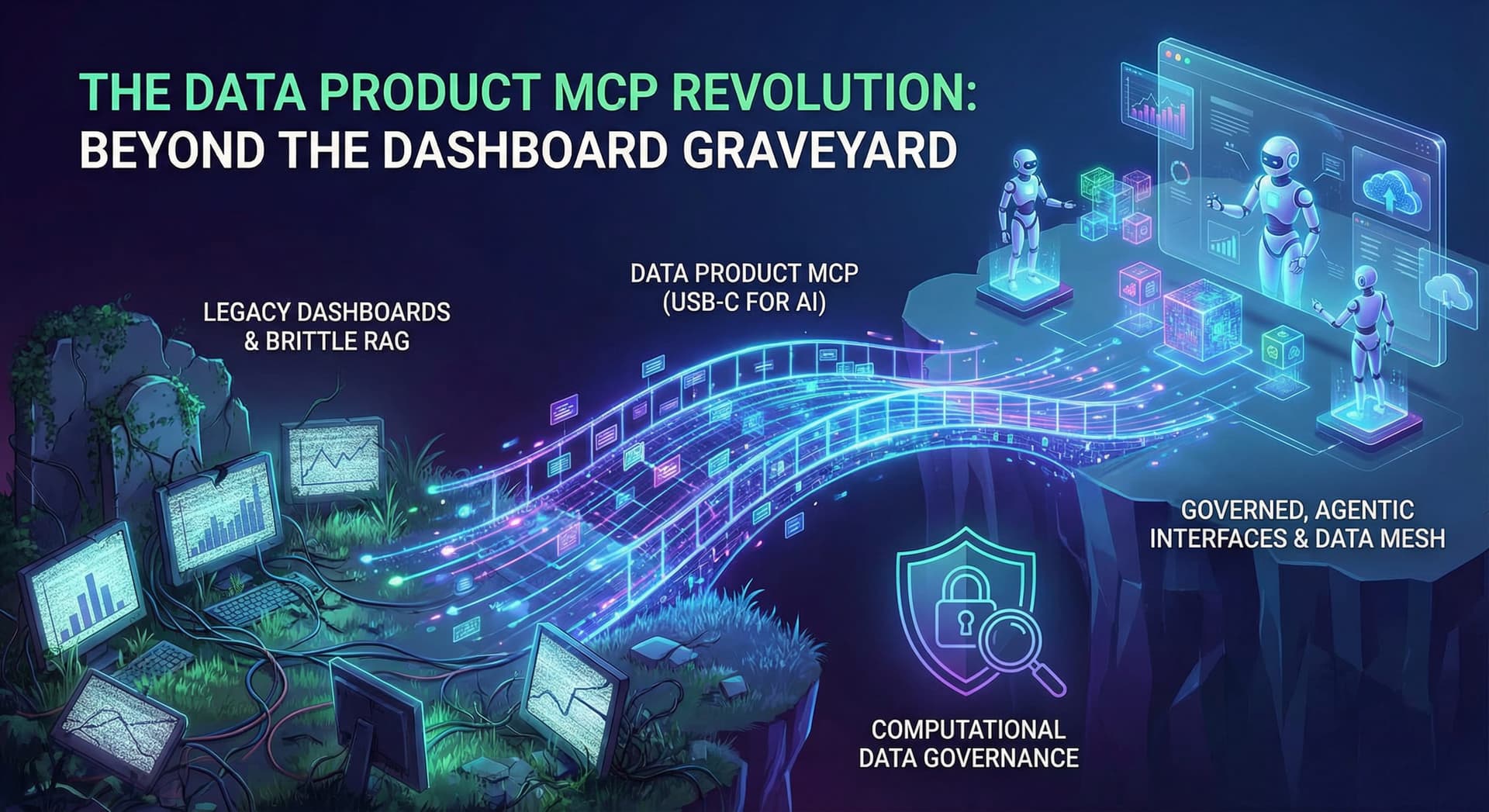
For decades, the “data-driven enterprise” has been buried in a graveyard of static dashboards. While the current wave of Generative AI promised a “Chat with your Data” revolution, the reality has been a fragmented mess of bespoke RAG (Retrieval-Augmented Generation) pipelines and error-prone SQL generation. These legacy AI approaches fail because they cannot navigate the context window limitations of modern Large Language Models (LLMs); they either drown the model in irrelevant schema noise or starve it of the business context necessary for accuracy.
The breakthrough is the Data Product MCP (Model Context Protocol). This represents the “USB-C moment” for enterprise data. By wrapping enterprise assets in a standardized architecture, we move beyond brittle, custom-coded integrations. This is the transition from Static, Human-Only Dashboards to Zero-Integration Agentic Interfaces. In this new paradigm, data is no longer something you explore manually; it is an active participant in an autonomous, governed conversation.
To turn fragmented databases into an interoperable ecosystem, we must deploy a standardized stack based on four core technical pillars:
For years, Data Mesh was a compelling theory sidelined by technical complexity. Data Product MCP provides the missing link for the four pillars: Domain Ownership, Data as a Product, Self-Serve Platforms, and Federated Governance.
[!TIP] THE VIRAL TAKE: A Data Product is not “production-ready” until it possesses an MCP-compliant conversational interface.
By utilizing tools like Entropy Data (formerly Data Mesh Manager), organizations can maintain a central marketplace that serves as the inventory for these products. This architecture enforces Federated Governance by separating the metadata management—the instructions on how to use the data—from the actual storage layers. Whether your data sits in Snowflake, Databricks, or GCP, it stays in situ. The MCP server acts as the gateway, allowing agents to find and utilize data across the entire organization without the data ever leaving its secure home.
The transition to Data Product MCP significantly reduces the technical barrier to entry while strengthening governance through automation.
The greatest barrier to AI adoption is the risk of unauthorized data exposure. Data Product MCP addresses this through Purpose-Based Governance, shifting security from a manual checklist to an automated enforcement layer.
By 2027, we will have transitioned fully to Computational Data Governance. SQL will no longer be a language for humans to write; it will function purely as a backend compilation language for AI agents. Any enterprise data asset that is not MCP-compliant will be “invisible” to the AI workforce, relegated to the silos of the past.
The goal is not merely “faster queries.” It is the creation of a data-democratic enterprise where the barrier to insight is removed for non-technical users. In this future, information is accessed through conversation, protected by a protocol that ensures every interaction is secure, governed, and mathematically faithful to the underlying data contract.
Thinking about Technology? Our team has helped 100+ companies turn AI insight into production reality.
Book a highly tactical 30-minute strategy session. We apply the engineering rigor developed with McKinsey, DHL, and Walmart to accelerate AI for startups and enterprises alike. Let's bypass the hype, evaluate your specific use case, and map a concrete path to production.
Establish your authority. Amplify these insights with your professional network.
Hand-picked insights to expand your understanding of the evolving AI landscape.