Technology
JEPA vs LLMs: The Architecture War That Will Define the Next Decade of AI
22 APR2026
10 MINRead
---
Views Sterlites
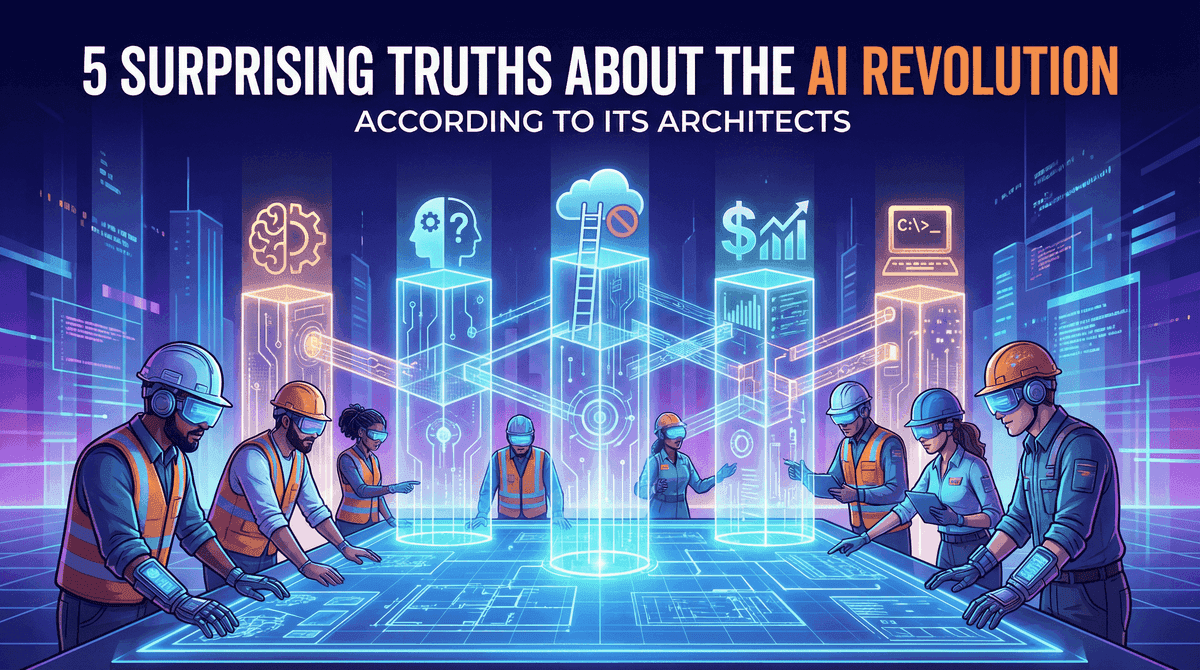
As we step into 2026, the news cycle around Artificial Intelligence remains a relentless firehose of product launches, breathless predictions, and existential warnings. To navigate the year ahead, separating fleeting hype from fundamental truth is essential.
This article distills five of the most surprising insights from the leaders building the future of AI. Drawing from recent talks by pioneers at OpenAI, Google, and Microsoft, these truths provide a definitive roadmap for the year ahead.
As AI assistants get better at writing code, a common piece of advice has emerged: don’t bother learning to code; AI will just do it for you. According to Andrew Ng, a foundational figure in the AI field, this is a dangerous misconception. He argues that as AI lowers the barrier to entry for software engineering, the value of being able to wield that power increases.
I think we’ll look back on this as some of the worst career advice ever given because as better tools make software engineering easier more people should do it not fewer.
Ng holds the controversial opinion that coding is the new literacy. On his own team, roles ranging from the CFO to the front desk receptionist utilize Python to automate workflows.
This reflects a fundamental shift: The most important skill in 2026 is Deterministic Control: the ability to tell a computer exactly what you want it to do. It’s not about memorizing syntax; it’s about having the mental model to direct an AI to generate precise, functional systems.
It’s tempting to anthropomorphize Large Language Models (LLMs) as super-smart humans. Andrej Karpathy, former director of AI at Tesla, warns that this analogy is fundamentally flawed. He describes LLMs as possessing “Jagged Intelligence”: a paradoxical mixture of superhuman abilities and startling deficits.
An LLM has encyclopedic knowledge and near-perfect recall, similar to the autistic savant character in Rain Man.
It suffers from Anterograde Amnesia. Unlike a human colleague who consolidates knowledge over time, an LLM’s core “weights” are frozen. Its context window is merely a temporary scratchpad that is wiped clean after every session.
LLMs are like the protagonists of Memento or 50 First Dates: entities whose memories are erased daily.
Combined with a susceptibility to hallucinations and prompt injection attacks, this “jagged” profile is a crucial reality check. You are not working with a human; you are working with a brilliant but amnesiac library.
A dominant narrative in AI has been that “Scale is all you need”: that bigger data centers will inevitably lead to Artificial General Intelligence (AGI).
Research from François Chollet, creator of Keras, provides a stark counter-narrative. He argues that scaling up current architectures improves “Crystallized Intelligence” (memorization) but fails to produce “Fluid Intelligence” (novel problem solving).
To prove this, Chollet created the ARC Benchmark (Abstraction and Reasoning Corpus). The results are damning:
So we can decisively conclude that fluid intelligence does not emerge from scaling up pre-training… you absolutely need test adaptation in order to demonstrate genuine fluid intelligence.
This suggests that 2026 will not be defined by larger models, but by Test-Time Adaptation: systems that can “think” and learn in real-time, rather than just reciting pre-trained patterns.
For decades, the software economy relied on the SaaS (Software-as-a-Service) model: selling licenses per human user. Aaron Levie, CEO of Box, argues that AI Agents are about to “completely blow up” this foundation.
The shift is from Tools to Outcomes. Traditional software helps a lawyer work faster; an AI Agent does the legal analysis.
I know you only have three lawyers, but my agents could do the amount of work of basically unlimited lawyers.
This transition to Service-as-Software means pricing will no longer be capped by headcount. It rewrites the total addressable market (TAM) for the entire tech industry, moving value capture from “productivity” to “labor replacement.”
Our primary interface for AI today is the Chatbot. While functional, visionaries like Dylan Field (CEO, Figma) and Sam Altman (CEO, OpenAI) view it as a primitive, temporary bridge.
”It feels intuitively like we’re in the MS-DOS era of AI right now.”, Dylan Field
Just as command-line interfaces eventually gave way to the Graphical User Interface (GUI), the “text box” is destined to become obsolete. Karpathy adds that while LLMs are a new “Operating System,” we are currently in the “1960s of OS design.” We lack the mouse, the window, and the desktop metaphor for this new intelligence.
The future isn’t a better chatbot; it is Ambient Intelligence. As Altman envisions, the interface will eventually “melt away,” leaving a trusted assistant that proactively navigates the digital world on your behalf, without you needing to type a single prompt.
From the revelation that AI demands more coders to the rewriting of the SaaS business model, the architects of this revolution see a future far more nuanced than the headlines suggest. We are living through a “Jagged” transition: defined by models with amnesia, interfaces as crude as MS-DOS, and limits to what raw scale can achieve.
As we stand at this precipice, Sam Altman offers a definitive call to action for builders:
This is the best f***ing time ever in the history of technology… ever, period… to start a company.
Thinking about Technology? Our team has helped 100+ companies turn AI insight into production reality.
Book a highly tactical 30-minute strategy session. We apply the engineering rigor developed with McKinsey, DHL, and Walmart to accelerate AI for startups and enterprises alike. Let's bypass the hype, evaluate your specific use case, and map a concrete path to production.
Establish your authority. Amplify these insights with your professional network.
Hand-picked insights to expand your understanding of the evolving AI landscape.