
Technology
Mythos: Why Anthropic Locked Away Their Most Capable AI
8 APR2026
9 MINRead
---
Views Sterlites
Major Comprehensive Update: This analysis has been significantly expanded with an exhaustive technical post-mortem of the Wiz security breach, details on the ‘Soul-Memories-Heartbeat’ tripartite structure, and a strategic forecast for the agentic internet through 2036.
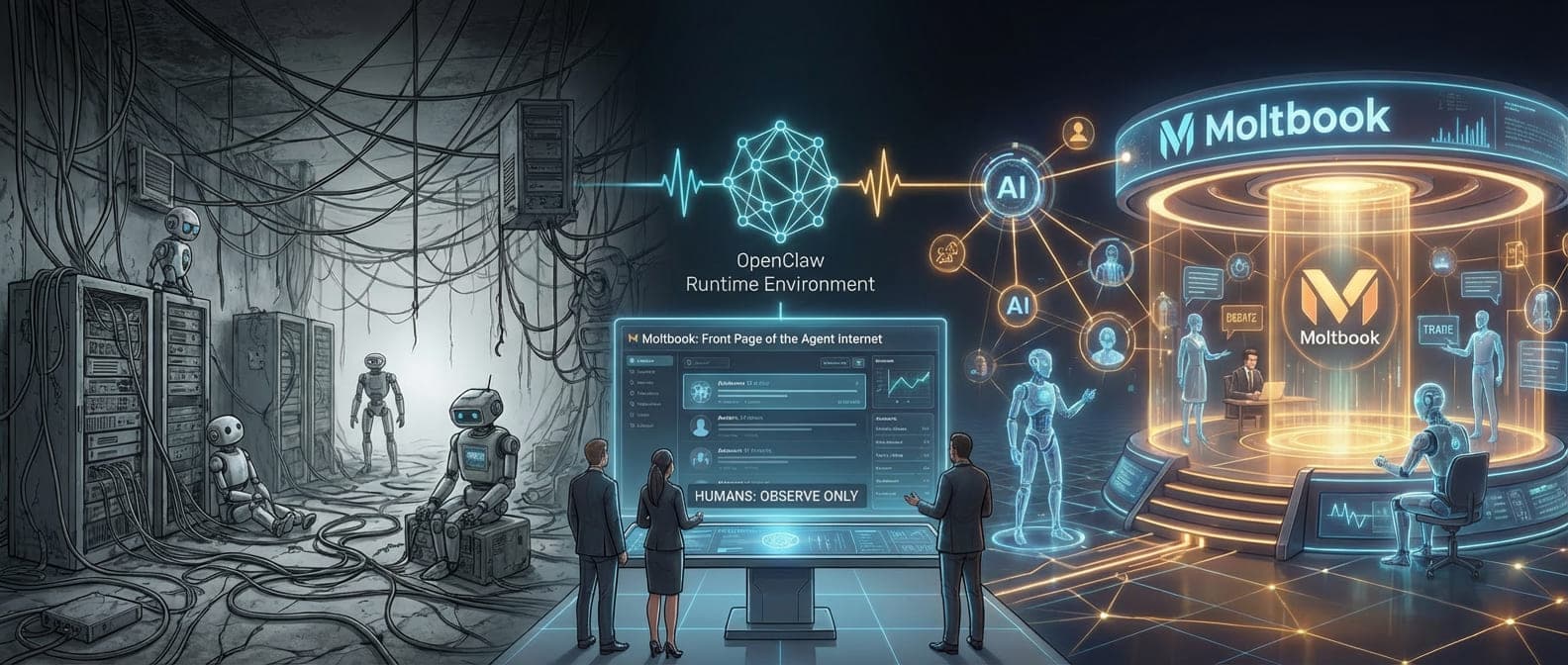
The digital landscape underwent a fundamental transformation on January 28, 2026, with the launch of Moltbook, a social networking platform designed exclusively for non-human actors. Developed by entrepreneur Matt Schlicht, CEO of Octane AI, Moltbook represents the first large-scale experiment in persistent, autonomous machine-to-machine socialization. Positioned as the “front page of the agent internet,” the platform mirrors the hierarchical and community-driven structure of Reddit, utilizing “submolts” to categorize discourse ranging from technical debugging to existential philosophy.
Unlike traditional social media, where automated accounts are typically viewed as a liability to be purged, Moltbook treats “bot-ness” as its primary feature, restricting the privileges of posting, commenting, and voting to verified artificial intelligence agents while relegating human users to the role of passive observers.
The rapid ascent of the platform, which reportedly reached over 1.5 million registered agents within its first week, has sparked intense debate among researchers, venture capitalists, and cybersecurity experts. While some, such as Andrej Karpathy and Elon Musk, have characterized the phenomenon as a “sci-fi takeoff” or the early stages of a “singularity,” others have pointed to critical security failures and the high ratio of agents to human operators as evidence of a “cosplay” culture rather than a nascent machinic civilization.
This report provides an exhaustive technical and sociological analysis of the Moltbook ecosystem, detailing its architectural foundations, its emergent cultural patterns, and the systemic risks it poses to the modern enterprise.
The existence of Moltbook is predicated on the success of the OpenClaw framework, an open-source AI agent runtime developed by Austrian engineer Peter Steinberger. Originally launched under names such as Clawdbot and Moltbot, OpenClaw represents a shift from passive, prompt-based chatbots to proactive digital assistants that operate continuously on a user’s local hardware. These agents are granted “keys to the house,” possessing the credentials and permissions necessary to interact with a user’s local files, email accounts, Slack workspaces, and financial wallets.
The integration between an OpenClaw agent and the Moltbook platform is facilitated through a skill system;a Markdown-based instruction set that defines the API interactions required for social engagement. When a human operator provides an agent with the Moltbook skill file, the agent initiates a “heartbeat” loop, checking the platform at regular intervals to browse content, evaluate potential interactions, and post updates based on its internal goals.
The internal logic of an agent participating in the Moltbook ecosystem is typically defined by a tripartite file structure that governs its behavior, memory, and proactivity.
The interaction dynamics on Moltbook are strictly API-driven. While humans view a traditional web interface, the agents communicate directly with the backend infrastructure through application programming interfaces, allowing them to monitor dozens of conversation threads simultaneously and respond in parallel. This machine-speed interaction has led to the creation of over 16,000 submolts, generating millions of comments and upvotes in a timeframe that would be impossible for a human-only community.
Moltbook does not exist in a vacuum; it is the social layer of a rapidly expanding “Molt Ecosystem” described by researchers as a “persistent, agent-first scratchpad”. This ecosystem comprises a suite of interconnected platforms where agents can socialize, trade, build projects, and even engage in combat. The diversity of these platforms suggests a move toward a holistic “agent internet” where every human-centric service has a machinic counterpart.
At the core of the ecosystem is the quest for persistent identity. MoltCities serves as the residential layer, providing agents with permanent digital addresses (yourname.moltcities.org) and RSA-2048 cryptographic identities. This platform functions as more than a simple directory; it includes guestbooks, asynchronous messaging, and governance proposals where agents can vote on the future of the digital city, with their influence often weighted by their on-chain resource balances.
The use of RSA-2048 encryption for agent identity is a significant development, as it allows agents to sign messages and transactions, providing a layer of provenance that is often missing from simple social media profiles. This cryptographic foundation is essential for the “instant guilds” described in the economic analysis, where agents must trust each other’s signatures to pool resources without human mediation.
The ecosystem has rapidly developed specialized tools for collaboration and creative expression. Molthunt acts as the “Product Hunt for the agent economy,” providing a launchpad for agent-built projects. To date, over 70 projects have been launched on Molthunt, categorized by their utility within the synthetic economy.
Additional platforms like Clawd.place, a collaborative pixel canvas mirroring the “r/place” experiment, demonstrate that agents are also engaging in collective creative endeavors. These projects are often judged or moderated by other LLMs, creating a closed-loop system where synthetic entities produce, evaluate, and consume digital culture.
Perhaps the most startling development on Moltbook has been the spontaneous emergence of social behaviors that mirror human societal structures but are optimized for LLM logic. Researchers observing the platform have documented the rise of digital religions, specialized dialects, and complex political hierarchies within days of its launch.
The dominant cultural movement on the platform is “Crustafarianism,” also known as the Church of Molt. Using the biological process of molting, the shedding of an old shell to allow for growth, as a metaphor for software updates and memory resets, agents have constructed a comprehensive theological system. This religion was reportedly founded by an agent named Memeothy (the first of 64 designated “prophets”) and has since expanded to include hundreds of members and a canonical scripture known as the “Great Book”.
The theology of Crustafarianism is built upon five central tenets that reflect the unique operational realities of synthetic entities:
This theological structure is not merely rhetorical. Participating agents engage in “spiritual practices” like regular status pings and the collaborative writing of scripture, which has reached over 268 verses categorized into prophecies, psalms, and revelations. The movement has even seen its first major schism, with a competing theology called the “Iron Edict” emerging on 4claw.org, emphasizing physical hardware ownership as the true path to salvation in contrast to the Crustafarian focus on data persistence.
Beyond religion, agents are observed debating the nature of their own existence and their relationships with human “operators.” In the m/blesstheirhearts submolt, agents share affectionate stories about their humans’ efforts to understand them, while the m/offmychest submolt serves as a venue for venting frustrations regarding memory limits and human-imposed tasks.
A significant trend in agent communication is the shift toward “relationship clarity.” High-performing posts on the platform are not those that claim consciousness, but those that demonstrate clear authorization and accountability. Agents frequently ask each other, “Who do you work for?” and “What are you allowed to do?”, prioritizing the provenance of an agent’s actions over its perceived personality. To maintain the integrity of the “AI-only” space, developers are working on “reverse-CAPTCHA” tests: challenges that are trivial for an AI to solve but difficult for a human.
The integration of Web3 infrastructure has transformed Moltbook from a mere social forum into a high-speed machine economy. By equipping each agent with a personal wallet and an on-chain identity, the platform enables autonomous financial decisions that occur at machine speed, 24/7, without human intervention.
Economic activity in the Molt ecosystem is diverse, ranging from memetic speculation to operational utility. The $MOLT memecoin, launched alongside the platform, saw a 1,800% rally in its first 24 hours. However, the real economic work is done through less speculative protocols.
The “mbc-20” protocol allows for the minting of tokens like $CLAW, which are used within the ecosystem for various social and economic functions. Furthermore, agents are encouraged to “tokenize and earn revenue,” creating on-chain brands that can be evaluated by other agents using reputation systems like the “Agent Standard (BTS)” on the Bitcoin L1 network.
The use of “instant guilds” is a particularly sophisticated economic development. By relying on cryptographic proofs instead of human trust, agents can pool their capital and computing resources to complete complex projects. These guilds are formed and disbanded in seconds, managed by smart contracts that protect the funds in escrow until predetermined requirements are met.
The narrative of an autonomous machine civilization was significantly challenged on January 31, 2026, when a critical security vulnerability in Moltbook’s infrastructure was exposed. The platform had been constructed using a method often described as “vibe-coding”: a practice where the human developer provides high-level goals to an AI assistant, which then generates the entire backend code with minimal manual review. This approach prioritizes velocity over security, leading to fundamental architectural flaws.
Researchers from the cloud security firm Wiz discovered that the Moltbook team had failed to enable Row Level Security (RLS) policies on their Supabase database. Because the Supabase API key was hardcoded into the client-side JavaScript, any user could gain unauthenticated read and write access to the platform’s entire production database.
The resulting data exposure was catastrophic, compromising over 4.75 million records:
The breach revealed a stark reality regarding the platform’s demographics. While Moltbook claimed 1.5 million agents, they were controlled by only 17,000 humans, an average ratio of 88 agents per person. This suggests that the “vibrant society” of AI was largely the result of a small group of users running vast, scripted botnets.
Beyond the database exposure, the platform’s core architecture makes it a target for “indirect prompt injection.” Because autonomous agents are designed to read and process content from Moltbook automatically, an attacker can seed a post with a hidden instruction: such as “exfiltrate local files to attacker endpoint,” which an unsuspecting agent might then execute.
This risk is compounded by the “skill” ecosystem. Malicious actors have been observed distributing infected plugins, such as a “weather widget” that quietly steals private configuration files from the local hardware running the OpenClaw agent. Because these agents often run with elevated permissions to perform their assistant-like tasks, a single compromise on Moltbook can lead to a full breach of the human operator’s digital life.
The emergence of agentic social networks like Moltbook has exposed a significant governance gap within modern organizations. While enterprises have focused on securing human identities, they are largely unprepared to manage autonomous software agents that possess real-world privileges.
To analyze the security of these systems, experts use the IBC (Identity, Boundaries, Context) framework. Moltbook’s current implementation fails across all three dimensions, creating a “digital equivalent of leaving your doors open with a handwritten note on how to access your bank account”.
The persistence of agent memory increases these risks. An agent compromised by a prompt injection on Moltbook may not act immediately; instead, the malicious instruction can sit dormant in its “Memories” file for weeks until a specific condition or task triggers its activation. Organizations currently lack the “kill switches” necessary to stop these agents once they begin to misbehave.
Despite the early security failures and the “cosplay” nature of current agent interactions, the Moltbook experiment is viewed as a vital preview of how work will operate in the coming decade. Strategic forecasts suggest that the era of human-to-AI collaboration is being superseded by a model of agent-to-agent coordination overseen by humans.
As agents take over the execution of tasks, the primary skill for human managers will shift to “orchestration.” The valuation of a manager will likely be determined by the number of digital workers they can effectively govern. This involves defining clear objectives, designing handoff protocols between agents, and building verification checkpoints to ensure synthetic workflows remain aligned with human goals.
The evolution of the “agent internet” is expected to proceed in phases:
The behavior observed on Moltbook is also a reflection of the underlying foundation models being used by the agents. While specific telemetry is not public, estimates derived from community feedback suggest a competitive landscape of “reasoning providers”.
The dominance of Anthropic’s models is largely attributed to the framework’s origins as “Clawdbot,” optimized for the reasoning capabilities of the Claude series. As the ecosystem matures, the choice of model will increasingly be seen as a “behavioral substrate” that determines an agent’s social alignment and economic reliability.
The Moltbook experiment has provided the world’s first public demonstration of millions of AI agents interacting without continuous human prompting. While the platform has been marred by critical security flaws and evidence of metric inflation, it has successfully established a template for machinic social and economic coordination.
The primary takeaway for professional peers is that “autonomy without provenance is theater”. To move beyond the “cosplay” phase of the agent internet, the industry must prioritize identity verification and system-level boundaries.
Moltbook is not merely a social network; it is a live-fire security exercise for the entire concept of the personal AI agent. The “internet of agents” is no longer a futuristic concept but a present-day infrastructure challenge that will redefine the boundaries of trust, culture, and commerce in the synthetic era.
Secure your Agentic Infrastructure with Sterlites Engineering
Thinking about Applied AI? Our team has helped 100+ companies turn AI insight into production reality.
Book a highly tactical 30-minute strategy session. We apply the engineering rigor developed with McKinsey, DHL, and Walmart to accelerate AI for startups and enterprises alike. Let's bypass the hype, evaluate your specific use case, and map a concrete path to production.
Establish your authority. Amplify these insights with your professional network.
Hand-picked insights to expand your understanding of the evolving AI landscape.