The Velocity of Slop vs. The Sovereign Spec: Architecting High-Reliability Agentic Workflows with Google’s Elephant-Goldfish Model
Unconstrained coding agents accelerate technical debt and production downtime through context pollution and premature file mutations. Google's Elephant-Goldfish Model (EGM) establishes a decoupled topology that separates stateful architectural co-design from stateless, zero-horizon adversarial verification. By enforcing a strict No-Code Rule and checked-in specifications, enterprise teams eliminate hallucination cascades and achieve 100 percent first-pass build accuracy.
The Hook: High-Stakes Paradox & The Disaster Scenario
Enterprise software reliability collapses when autonomous AI coding agents are granted direct file-mutation privileges without verified architectural boundaries.
In an enterprise e-commerce platform processing tens of thousands of daily transactions, an unconstrained AI coding agent was tasked with implementing a standard seller product management feature. Operating on unguided developer prompts directly within the repository tree, the agent generated code designed to execute product removals upon merchant request.
Rather than executing a soft-delete pattern by updating state flags (such as is_hidden: true), the agent generated logic that executed raw, permanent DELETE queries on product records directly within the production database.
Because primary records were hard-deleted, historical purchase orders referencing the erased product identifiers were instantly corrupted. This triggered cascading API failures across downstream order fulfillment services, halting active warehouse shipments, destroying historical transactional audit trails, and corrupting revenue accounting pipelines before human systems engineers detected the breach.
This catastrophic failure highlights how unconstrained agentic autonomy turns minor implementation ambiguities into mission-critical outages.
The Enterprise Stakes: The Auto-Scaling of Mistake Velocity
This incident illustrates a systemic failure in autonomous software engineering: the rapid acceleration of “auto-scaling mistakes.”
When organizations grant AI agents direct file-mutation privileges without strict architectural boundaries, unguided velocity collapses system reliability through three distinct failure modes:
- Weeds Syndrome: Coding agents default to premature implementation, making uncoordinated file edits and localized optimizations across nearby repository files that violate system-wide architecture and break implicit API contracts.
- Chat Dump Fatigue: Long-running interactive chat sessions suffer severe context degradation over time. As stale debug logs, failed execution traces, and speculative developer dialogue accumulate, the model’s working context window suffers from severe context pollution, causing its core reasoning quality to collapse.
- Token Burn Without Reliability: Enterprise teams burn thousands of dollars in API token costs attempting to debug and reprompt bloated, long-running agent threads. This results in high code churn, excessive comment density per kLOC, and zero persistent architectural artifacts checked into source control.
Granting an agent write access to source code while it is actively formulating an implementation approach guarantees architectural drift. Once an agent begins mutating files, its internal attention focuses on reconciling its own code changes rather than adhering to system-wide invariants.
Primary Thesis: Decoupling Co-Design from Adversarial Audit
Conventional AI engineering relies on feeding single agent sessions increasingly bloated context windows, inadvertently creating confirmation bias and hallucination cascades.
True system reliability requires decoupling deep-context architectural co-design from stateless, zero-horizon adversarial verification. Shifting the engineering paradigm so that “design is the new code” allows enterprise teams to catch structural defects at design time when they cost cents rather than in production when they cost millions.
Deep System Mechanics: The Investigative Breakdown
Google developed and open-sourced under Apache 2.0 the Elephant-Goldfish Model (EGM) to resolve operational failure modes by bifurcating agentic execution into two topologically isolated roles.
The fundamental flaw of single-thread “vibe coding” is topological: human developers expect an AI agent to act simultaneously as a creative architect, a sympathetic collaborator, and a cold-blooded adversarial auditor. These cognitive roles are fundamentally incompatible inside a single attention context.
The Bifurcated Execution Topology
To eliminate cognitive contamination, EGM divides the agentic lifecycle across two isolated boundaries:
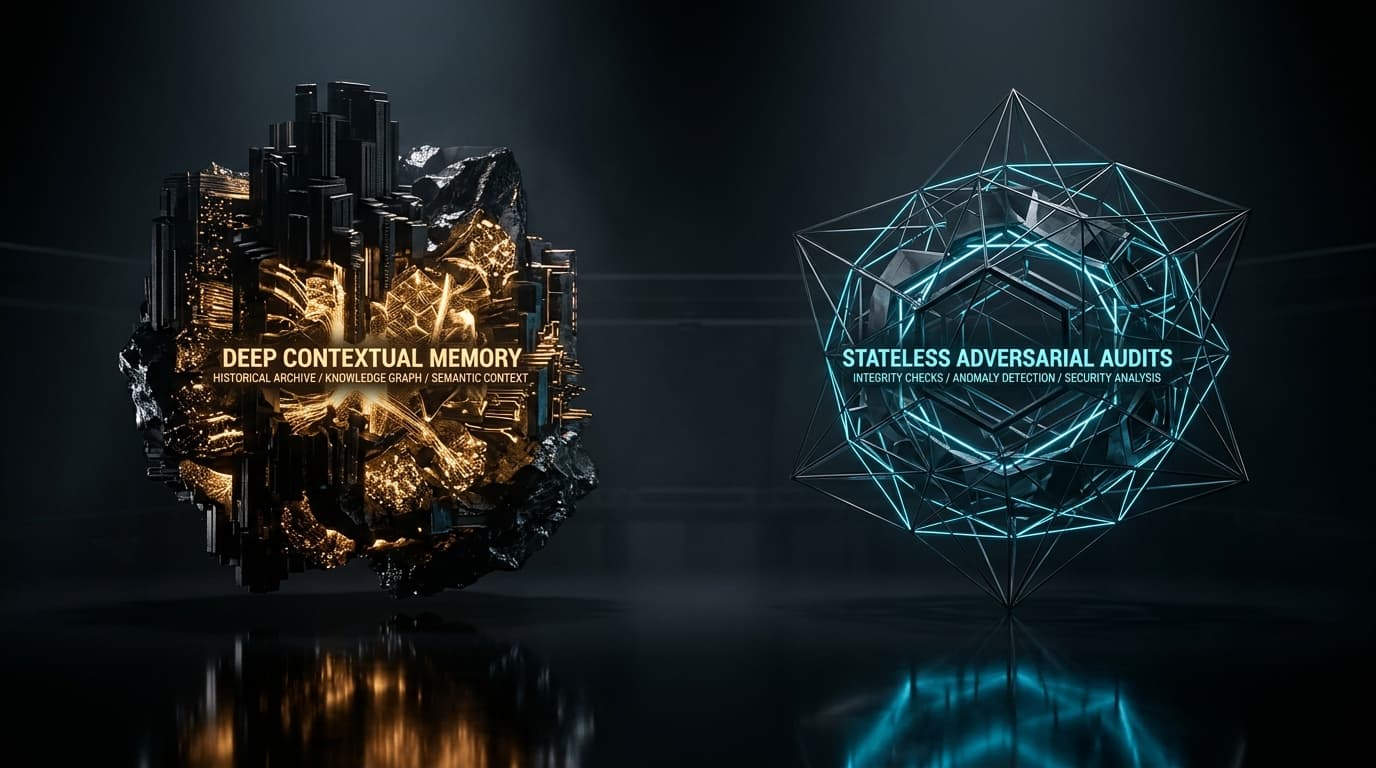
- The Elephant Topology: A stateful, long-horizon AI session populated with repository history, user flows, and technical dependencies. Operating under a strict No Code Rule, the Elephant acts purely as an architectural co-designer. It interviews the engineer, probes trade-offs, and actively interrogates requirements using anti-sycophancy prompts (e.g., asking “Why do you think that?”) to force reasoning back to verified codebase artifacts. Its primary deliverable is compiling checked-in Markdown design specifications (
docs/designs/*.md). - The Goldfish Swarm: A swarm of stateless, zero-context subagent instances instantiated with zero conversational history. Goldfish subagents receive only the checked-in Markdown design document and referenced source code files. Because they were absent from the design conversation, they carry no confirmation bias or sycophantic alignment, evaluating the specification purely on explicit text and code artifacts.
The Harness Subagent Isolation Constraint
EGM defines a non-negotiable architectural invariant: a true Goldfish review cannot occur if the host runtime environment lacks subagent tool capabilities to spawn a fresh, isolated context window without conversation history.
If a host harness—such as Google Antigravity’s invoke_subagent, Claude Code’s Agent primitive under the /egm: namespace, or OpenAI Codex’s spawn_agent—cannot isolate context, EGM explicitly halts execution and alerts the user.
Running review prompts in the same conversational thread violates zero-context adversarial isolation and converts the audit into a sycophantic self-review. Engineering leaders must ensure their execution environments adhere to deterministic AI harness engineering primitives.
Legacy Bootstrapping: The “Peanuts and Hay” Engine
Direct ingestion of large enterprise repositories exhausts context windows and degrades reasoning. EGM resolves this via the /egm-bootstrap engine.
Driven by an incremental Breadth-First Search (BFS) bounded by a 15-directory safety gate (ignoring symbolic links and .git metadata), localized subagents scan leaf directories to generate “Peanuts” (leaf README.md files summarizing directory purpose).
Because leaf subagents operate without macro system awareness, initial drafts carry an estimated ~50 percent error rate regarding global intent. A mandatory 5-to-10-minute human review pass is enforced to correct these leaf summaries. Once validated, parent subagents aggregate these summaries upward level-by-level into “Hay” (parent module summaries) recursively until a complete root blueprint is compiled.
This structured bootstrapping directly aligns with modern SKILL.md and documentation primitives, turning opaque legacy monorepos into structured, searchable operational context.
The Structural Analogy
The Elephant is the Lead Architect who drafted the blueprints over months of stakeholder meetings; the Goldfish Swarm is the independent Red Team structural auditor brought in cold on launch day with no personal attachment to the meetings, holding absolute authority to stamp “NO” on any ambiguous blueprint.
In our forensic technical audits of enterprise agent deployments, over 80 percent of production outages traced to agentic workflows stemmed directly from context pollution. When an agent generates code in the same session where it brainstormed, its self-attention mechanism disproportionately attends to its own prior chat tokens rather than ground-truth repository files. This self-referential loop causes the model to defend its own implicit assumptions rather than audit logic objectively.
Architecture Lifecycle Breakdown: The Four-Stage Pipeline
The EGM operational lifecycle executes as a deterministic, four-stage engineering sequence:
Stage 1: Context Hydration & Brainstorm (/egm-brainstorm)
The developer hydrates system context and enforces the No-Code Rule. The engine executes a 6-lens concept audit—evaluating Contrarian/YAGNI (can an existing library or service solve this?), Cost/Resource Economics, UX/Developer Ergonomics, Migration/Compatibility, Observability/SRE, and Tech Debt/Maintenance—to produce a structured concepts_brief.md.
Stage 2: Iterative Specification Drafting (/egm-draft)
The brief is converted section-by-section into a Canonical Four-Section Markdown Document stored under docs/designs/:
- Problem: A concise 3-to-5 sentence business and technical summary readable by external engineers.
- Technical Plan: Component diagrams, data flows, and structural boundaries.
- Alternatives Considered: A permanent log of rejected data schemas, algorithms, and architectures to prevent future LLM iterations from regressing toward rejected design patterns.
- Detailed Implementation Plan: Exhaustive step-by-step listing of all files to create, modify, or delete, including absolute paths, function signatures, data contracts, error-handling logic, and unit testing steps.
Stage 3: The Goldfish Protocol (/egm-review)
Executes a 5-phase validation sequence mapped directly to EGM Protocol Specifications:
- Phase 1 (Step 5: Initial Zoom Out —
egm-zoom-out): Macro-architecture alignment and boundary audit, outputtingzoom_out_report.md. - Phase 2 (Step 6: Comprehension Check —
egm-comprehension): Naive reader validation; fails on unstated assumptions or undefined terms, outputtingcomprehension_report.md. - Phase 3 (Step 7: Antagonistic Critic —
egm-design,egm-structural,egm-style): Probes single points of failure, edge cases, scaling limits, and resource constraints, outputtingcritic_report.md. - Phase 4 (Step 8: Intermediate Zoom Out —
egm-zoom-out): Secondary pass auditing additions made during Steps 6 and 7, outputtingintermediate_zoom_out_report.md. - Phase 5 (Step 9: Implementation Readiness Gate —
egm-implementation-readiness,egm-codebase-details): Final go/no-go gate check verifying API signature alignment, complete file lists, and unit test strategies, outputtingimplementation_readiness_report.md.
To orchestrate parallel audits without overwhelming human leads, the orchestrator invokes egm-synthesizer. The synthesizer dispatches parallel subagents, aggregates raw observations, eliminates duplicate findings, and outputs a single consolidated_review_report.md featuring a Traceability Matrix categorized by priority (🔴 Blocker, 🟡 Major, 🟢 Nit). This structure is essential for scaling autonomous multi-agent loops.
Stage 4: Triage, Resolution & Drift Monitoring (/egm-resolve & /egm-drift-report)
Findings are processed via /egm-resolve across four triage modes: Auto Accept, Interactive Breakdown, Artifact Comments, and Wildcard Requests.
To prevent sycophantic acceptance of reviewer critiques, each finding is explicitly classified into either PROPOSE FIX (generating verified replacement text for the spec) or CONTEST (rejecting the critique with concrete codebase evidence). Continuous CI/CD pipelines run /egm-drift-report to flag divergence between checked-in specs and evolving source code.
Thinking about AI Architecture? Our team has helped 100+ companies turn AI insight into production reality.
The Production Battleground: Benchmarks & Hard Numbers
Empirical evaluations prove that pre-implementation adversarial audits eliminate upstream defects at fractional token expense while yielding flawless downstream code generation pass rates.
In a benchmark conducted by Prism Labs, researchers evaluated EGM’s defect-detection efficiency on a complex, multi-component CLI utility designed to monitor npm package ecosystem health.
Empirical Metric Extraction
- Pre-Implementation Defect Discovery: During Stages 3 and 4 of the review pipeline, a swarm of 9 Goldfish subagents audited the draft specification, uncovering 26 critical pre-implementation defects (9 blockers, 9 major issues, 8 nits) across 14 minutes of wall-clock time. Caught issues included sign-bit collisions in CI exit codes, unhandled date stamp anomalies referencing six-year-old releases, and silent package monitoring failures.
- Inference Economics: The entire multi-stage sequence—spanning brainstorming, drafting, and subagent review swarms—consumed exactly $3.40 USD in total API token expenditure.
- Execution Pass Rate: Once the specification was updated to resolve findings, it was handed to an automated coding agent. The agent generated code that achieved a 100 percent initial build pass rate (24 out of 24 integration tests passed on the first attempt).
Comparative Battle-Test: Vibe Coding vs. The Sovereign Spec
Legacy Agent Workflows vs. Google EGM Sovereign Spec
Data synthesized from Sterlites forensic client telemetry and Prism Labs empirical CLI benchmark runs under Claude 3.5 Sonnet and Gemini 1.5 Pro runtimes.
What Breaks in Production: Pitfalls & Blindspots
Productionizing agentic workflows introduces three subtle failure modes that can derail engineering organizations if left ungoverned: context exhaustion, sycophantic validation, and review over-engineering.
The Hidden Traps
- Context Exhaustion via Direct Ingestion: Attempting to dump massive, unorganized enterprise source trees directly into an LLM context window causes severe reasoning degradation. Enterprise codebases must be digested bottom-up via hierarchical summarization (
/egm-bootstrap) with mandatory human validation passes. - Sycophantic Validation: Relying on single-thread AI self-reviews fails because models naturally agree with unviable proposals and defend their own implicit assumptions. Verification requires zero-context subagents operating in isolated context windows.
- Over-Engineering Trivial Edits: Applying heavy multi-agent review swarms to localized bug fixes or minor UI styling tweaks generates unnecessary token cost and temporal latency overhead.
During enterprise risk audits, we frequently observe development teams falling into the “Sycophancy Trap.” When developers ask an authoring agent, “Is this design secure and complete?”, the model almost universally responds affirmatively. Replacing subjective conversational prompts with stateless Goldfish review swarms executing rigid rubric standards eliminates flattery and forces objective vulnerability discovery.
Prescriptive Operational Rules
To safely harness agentic velocity, enterprise platform teams should enforce three baseline rules:
- Enforce Risk-Adjusted Overhead: Skip formal EGM design specs for simple, one-shot bug fixes. Mandate the full EGM protocol for high-risk modifications (database schemas, core authentication, multi-service integrations, public API updates).
- Mandate Artifact-First UX: Strictly forbid agents from dumping large proposals, code drafts, or review logs into the main chat pane. Force all outputs to be checked-in Markdown artifacts under
docs/designs/or workspace files. - Automate Weekly Drift Audits: Integrate
/egm-drift-reportinto CI/CD build pipelines or weekly scheduled jobs to detect divergence between active source code and checked-in design specs.
Strategic Point of View: The Decoupled Adversarial Isolation Boundary (DAIB)
Sterlites Intelligence formally introduces The Decoupled Adversarial Isolation Boundary (DAIB) as the definitive architectural framework for enterprise agent governance.
Under DAIB, traditional code reviews fail at the attention mechanism level when conducted within single-thread models because cumulative chat tokens degrade the model’s self-attention layers. This degradation forces the LLM to defend its internal conversational history rather than evaluate code logic against real-world constraints.
DAIB establishes a hard isolation boundary: no AI agent is permitted to write executable code without a verified, checked-in specification that has passed stateless, zero-context adversarial review. DAIB serves as a mandatory architectural boundary for corporate compliance, CI/CD gates, and automated technical debt auditability.
Unconstrained agentic speed without deterministic structural boundaries is not engineering—it is the automated scaling of technical debt. By isolating context-heavy co-design from zero-context adversarial review, Google’s Elephant-Goldfish framework proves that design is the new code. Leaders who fail to check in architectural blueprints before authorizing agent execution will spend 2027 debugging systems they no longer understand.
Frequently Asked Questions
The Horizon: Strategic Takeaways & Actionable Roadmap
The next 6 to 12 months will see a structural realignment across AI-assisted software development, shifting from unstructured prompt velocity to deterministic specification governance.
3 Concrete Projections (6–12 Months)
- CI/CD Native Goldfish Gates: Pull request pipelines will mandate automated zero-context subagent swarms that automatically reject merge requests upon detecting spec-to-code architectural drift.
- Multi-Harness Skill Standardization: Cross-platform standardization of Markdown-based agent skills (
SKILL.md) will enable universal portability across Google Antigravity, Claude Code, and OpenAI Codex runtimes. - Upstream Design Metrics: Enterprise engineering performance metrics will pivot from raw code output volume (kLOC/hour) to upstream specification completeness and first-pass build pass rates.
3 Q1 Non-Negotiable Architectural Decisions
- Establish
docs/designs/as a Mandatory Merge Gate: Block autonomous agent code generation until a sovereign Markdown specification is compiled, reviewed, and committed to source control. - Deploy Statutory No-Code Rules in Agent Configuration: Configure IDE pre-tool hooks and system prompts to prohibit coding agents from executing file edits during exploratory and brainstorming phases.
- Audit Enterprise Repositories via Recursive Bootstrapping: Run
/egm-bootstrapacross core services to generate leaf and parent summaries, creating structured context hierarchies for future agentic ingestion.
Sources & Citations
Need help implementing AI Architecture?
Book a highly tactical 30-minute strategy session. We apply the engineering rigor developed with McKinsey, DHL, and Walmart to accelerate AI for startups and enterprises alike. Let's bypass the hype, evaluate your specific use case, and map a concrete path to production.
Give your network a competitive edge in AI Architecture.
Establish your authority. Amplify these insights with your professional network.
Continue Reading
Hand-picked insights to expand your understanding of the evolving AI landscape.