Business Strategy
AI for Business: A CEO’s Strategy for Real ROI
3 APR2026
7 MINRead
---
Views Sterlites
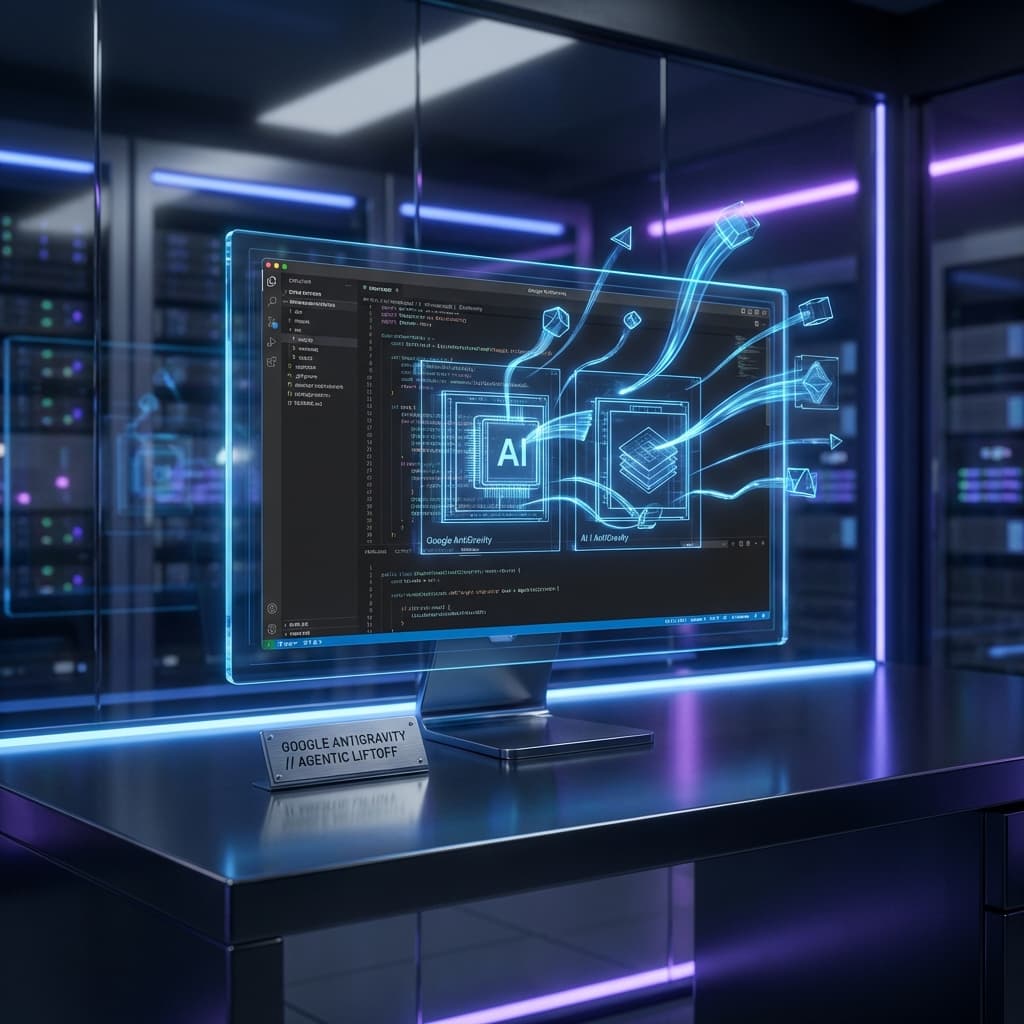
The release of Google AntiGravity on November 18, 2025, represents a definitive pivot point in the history of software development environments, signaling the transition from assistive tools to autonomous agentic platforms. While the preceding decade focused on the refinement of the Integrated Development Environment (IDE) as a high-fidelity text editor with integrated debugging and autocomplete, AntiGravity introduces an agent-first paradigm that presupposes the AI is the primary worker rather than a background assistant.
This shift is necessitated by the increasing complexity of modern software stacks, where the cognitive “gravity” of managing environment configurations, boilerplate code, and multi-surface testing has reached a point of diminishing returns for human developers. By leveraging the Gemini 3 model family, specifically optimized for acting and tool use, AntiGravity attempts to elevate the developer from a line-by-line typist to a high-level system architect.
AntiGravity is not just an update to VS Code; it is a fundamental re-engineering of the workspace where the agent is the primary inhabitant, and the developer acts as the project’s Mission Control.
The architectural origins of AntiGravity are rooted in a strategic “Founder Mode” pivot led by Google co-founder Sergey Brin. After returning to active daily operations, Brin identified a critical gap between Google’s frontier models and the tools used to deploy them, leading to a mission to move the company from “Search” to “Action.”
The realization was that traditional IDEs, such as Visual Studio Code, were fundamentally built for human input, assuming a synchronous, linear workflow. To accelerate the development of a platform that assumed an AI agent as the primary actor, Google executed a $2.4 billion acquisition of the startup Windsurf. Windsurf had successfully engineered a system where AI agents could interact with an IDE’s internal state through a proprietary system called Cascade. AntiGravity is, technically, a heavily modified fork of VS Code that incorporates the DNA of Windsurf, resulting in what the developer community has termed a “PORK” (Proprietary Fork).
This hybridization allows AntiGravity to maintain compatibility with the vast ecosystem of VS Code extensions while radically altering the core user experience to prioritize agent management. The integration of Cascade’s agentic logic into the Gemini 3 Pro foundation enables the platform to navigate the “heavy” aspects of development, debugging, refactoring, and environment setup, with a level of autonomy previously unseen in commercial coding tools. Explore the broader context of agentic AI transformation in the enterprise.
A fundamental innovation of AntiGravity is its structural departure from the single-window interface. The platform is built around two primary views that cater to different cognitive modes of development: the Editor View and the Agent Manager.
Each component is designed to minimize context switching and maximize agentic transparency.
The Editor View provides a familiar environment for developers who wish to remain “hands-on” with the codebase. It includes traditional AI features such as tab completions and inline refactoring commands, but enhances them with a fully functional agent side panel. In this mode, the agent functions as a high-powered pair programmer with direct access to the terminal and browser, allowing it to execute commands or test web components as the developer types.
The true power of AntiGravity lies in the Agent Manager, a dedicated interface designed for spawning and observing multiple agents working across different workspaces in parallel. This view “flips the paradigm” by embedding the development surfaces, the editor, terminal, and browser, into the agent’s workspace rather than the other way around.
A developer can dispatch five different agents to handle five separate bug tickets simultaneously, monitoring their progress through real-time status indicators (Running, Success, or Failed). This asynchronous model addresses the primary limitation of chatbot-style interfaces: the need for the human to wait for the AI to finish one task before beginning another. Learn how local-first agents like Moltbot integrate with this new orchestration paradigm.
A significant barrier to the adoption of autonomous coding agents is the lack of transparency in their reasoning processes. Traditional assistants often present a “black box” where the user either sees every raw tool call (leading to cognitive overload) or only the final code change (leading to a lack of trust). AntiGravity addresses this by mandating that agents generate “Artifacts”, tangible, task-level deliverables that provide sufficient context for human verification.
Artifacts provide a natural abstraction of the agent’s work, allowing the developer to audit logic at a glance rather than reviewing thousands of lines of terminal logs.
Trust in autonomous agents isn’t built on faith; it’s built on the verifiability of every step. The Artifact system turns the ‘black box’ of AI into a transparent, auditable process.
The integration of a feedback ecosystem similar to Google Docs allows developers to leave comments directly on these artifacts. For example, a developer can highlight a section of a screenshot or a step in an implementation plan and provide corrective feedback, which the agent automatically incorporates into its execution flow without stopping.
AntiGravity is the first product to fully utilize the Gemini 3 model family, which transitions from the “reasoning” focus of Gemini 2 to an “acting” focus. This is facilitated by the Interactions API, a unified foundation designed for building with both models and agents.
The Interactions API addresses the limitations of stateless text generation by providing built-in state management through interaction IDs. Instead of manually managing conversation history, developers can reference a previous_interaction_id, allowing the agent to maintain deep context over long-running sessions.
This API is multimodal native, handling text, images, audio, and video inputs while generating multimodal outputs like audio and images directly within the interaction. This capability is what enables “vibe coding,” where a developer can provide a screenshot of a design and ask the agent to “implement this,” knowing the model can interpret the visual aesthetic and translate it into CSS.
One of the most distinctive features of AntiGravity is its integration with Nano Banana Pro, a Gemini 3-based image generation and editing model. Unlike generic image generators, Nano Banana Pro is designed for professional-grade developer workflows, featuring state-of-the-art typography and Google Search grounding.
Nano Banana Pro allows agents to generate high-fidelity UI mockups before writing a single line of code. This allows for a “Visual Feedback Loop” where the developer can approve the look and feel of a component, such as a neo-brutalistic dashboard or a glassmorphic mobile screen, before the agent begins the technical implementation.
This integration effectively eliminates the need for separate design tools for prototyping, as the agent can act as both the designer and the engineer.
AntiGravity introduces a lightweight, file-based standard for extending agent capabilities called “Agent Skills.” A Skill is a directory-based package containing a SKILL.md definition file and optional supporting assets like scripts and templates.
Unlike a system prompt, which is always loaded and consumes context window tokens, a Skill is only loaded when the agent determines it is relevant to the user’s current request based on its semantic description. This prevents “instruction fatigue” and “context rot,” where the model becomes confused by too many irrelevant tools.
.agent/skills/, these are project-specific, such as database migration scripts or proprietary team conventions.~/.gemini/antigravity/skills/, these apply across all projects, such as a “Git Commit Formatter” or a “License Header Adder.” Explore our deep dive into the architecture of the skills.md standard.AntiGravity positions itself as a central hub for the developer ecosystem through its support for the Model Context Protocol (MCP). MCP acts as the “USB-C for AI,” providing a standardized bridge between the IDE and external data sources, tools, and services.
The platform features a built-in MCP Store where developers can discover and install pre-configured servers for Google Cloud services such as AlloyDB, BigQuery, and Spanner. This integration allows agents to securely interact with production data, enabling them to:
While much of the agent’s reasoning occurs in the cloud, AntiGravity emphasizes a “local-first” architecture to ensure privacy, lower latency, and offline capability. This is supported by the release of FunctionGemma 270M, a specialized model designed to run entirely offline on the user’s device.
FunctionGemma is an intent-to-API router that translates natural language commands, such as “Refactor the local auth module” or “Setup a new Python environment,” into actual function calls that the local machine can execute instantly. This model handles approximately 90% of routine, simple tasks without needing to send data to the cloud.
The transition to an agentic IDE changes the “meta” of software development. Developers are encouraged to implement a “Tech Stack Constitution”, a root file like ARCHITECTURE.md that explicitly defines the technologies, SDKs, and patterns the agents are allowed to use. This prevents agents from using deprecated libraries or “lazy” patterns found in their training data.
Navigating Google’s diverse toolset is critical for modern engineering teams. AntiGravity is designed for high-capability, high-management tasks that require autonomous orchestration.
Google AntiGravity is not merely a new IDE but a new paradigm for the software development lifecycle. By shifting the focus from manual coding to task orchestration, and from autocomplete to autonomous verification, it allows developers to operate at a higher level of abstraction. The integration of the Gemini 3 acting-focused models, the Nano Banana visual suite, and the modular Agent Skills framework creates a comprehensive ecosystem where ideas can be realized at the speed of thought.
As the platform matures from public preview into a stable enterprise solution, the primary role of the developer will continue to evolve from a writer of code to a manager of intelligence. The “gravity” of technical debt and boilerplate is being lifted, enabling a new era where the vision and design of the architect are the only limits to innovation.
Contact Sterlites Engineering to explore how we can help you integrate agentic workflows into your development lifecycle.
Thinking about AI Development? Our team has helped 100+ companies turn AI insight into production reality.
Book a highly tactical 30-minute strategy session. We apply the engineering rigor developed with McKinsey, DHL, and Walmart to accelerate AI for startups and enterprises alike. Let's bypass the hype, evaluate your specific use case, and map a concrete path to production.
Establish your authority. Amplify these insights with your professional network.
Hand-picked insights to expand your understanding of the evolving AI landscape.