
Engineering
The Architecture of Agency: A 2026 Guide to Agentic Engineering
11 FEB2026
8 MINRead
---
Views Sterlites
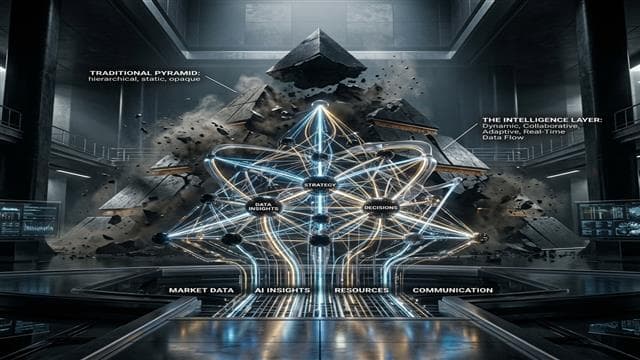
The $1 trillion enterprise software repricing of early February 2026 was not a market bubble: it was a clinical signal that the era of un-integrated interface wrappers is officially over. Firms tethered to seat-based extraction are drowning in “business model debt”, leaving them defenseless against leaner, agentic competitors. You are likely shipping AI features into an organizational structure that is fundamentally incompatible with the physics of agentic workflows. By the end of this guide, you will know exactly which structural decisions cost enterprises their survival and how to transition from AI-enabled feature-bloat to an AI-native organization operating as a high-velocity intelligence layer.
In early 2026, the market sent a clear mandate: if your software merely organizes and displays information, you are obsolete. According to SaaStr and Chargebee data, AI budgets are expanding at greater than 100 percent year-over-year, while total IT growth has stagnated at 8 percent. This is not new capital. It is the aggressive harvesting of legacy SaaS budgets to fund agentic orchestration.
Think of attempting to be “AI-enabled” without re-architecting your core billing like mounting a jet engine on a horse-drawn carriage: the structural frame will inevitably disintegrate under the velocity of the intelligence.
The threat to incumbents is Business Model Debt (the terminal constraint of legacy ARR). Seat-based pricing creates a perverse incentive to resist automation because value is tied to human labor rather than outcomes. NVIDIA CEO Jensen Huang characterized the software is dead narrative as illogical, but the reality is a repricing of the mechanism of value. In 2026, value is found in execution. If the dashboard is no longer the destination, the intelligence layer must become the product.
Consider Abridge in the healthcare sector. Instead of selling a platform where doctors spend hours typing clinical notes, they sell the finished, compliant note directly. The outcome is the product, completely bypassing the human data-entry bottleneck.
For two millennia, organizations have utilized the Roman military model of nested hierarchies built around a limited “span of control” (typically 8 to 1) to route information. The Prussian reformers later added middle management to pre-compute decisions and maintain alignment for leaders who lacked the bandwidth to see the whole field. Today, AI renders this manual information routing protocol technically redundant.
The future is the Queryable Organization. In this model, the firm operates as a “Company World Model” where every decision, discussion, and artifact is machine-readable and legible. Unlike humans, AI has an infinite span of control, capable of maintaining a continuously updated model of the entire enterprise simultaneously. This enables the “20x Company”, a Y Combinator concept describing teams of three achieving the output of sixty.
This is realized through closed loops:
This shift enables the 10,000x Engineer: a single IC utilizing a system of agents to build entire workflows that previously required massive engineering departments.
The smartest companies in 2026 don’t just sell intelligence; they sell the removal of friction. The winners will be those who prioritize the liquidity of their business model, ensuring revenue is tethered to actual agentic value rather than human seats.
The classic management pyramid is a lossy system where information is fragmented and manually filtered as it ascends. AI-native firms collapse this hierarchy into three distinct archetypes:
In 2026, the best companies focus on token-maxing rather than headcount. They run uncomfortably lean, accepting high API bills as a superior alternative to inflated, expensive human middleware.
A high monthly inference bill is no longer a cost center to be minimized. It is proof that you have successfully shifted operations from slow human middleware to high-velocity intelligence.
The shift from SaaS to AI-native creates immediate margin compression. Traditional SaaS enjoyed roughly 80 percent gross margins due to zero marginal costs. AI, however, is compute-intensive. ICONIQ 2026 data estimates AI-native gross margins at approximately 52 percent. Surviving this requires a shift from software extraction to economic adaptability.
This shift forces organizations to treat AI providers as high-impact, regulated vendors. Disruption is now a function of business model design rather than mere product features.
Public scrutiny is rising, exemplified by civil rights groups suing major AI labs over the environmental harms caused by data centers. As Wade Foster of Zapier notes, economic adaptability is the new feature velocity.
We define the Kinetic Intelligence Loop as a framework where every customer interaction automatically updates the company’s operational model.
Think of the Kinetic Intelligence Loop like a biological immune system: the moment it encounters a new problem or failure, it automatically generates a specific antibody (a new process or code primitive) to solve it.
The mechanism operates via Artifact Generation to Vector Ingestion to Agentic Optimization. The implication is profound: the product roadmap is no longer a PM hypothesis. It is a generated failure signal. When the intelligence layer fails to compose a solution because a primitive is missing, that failure becomes the immediate, automated priority for the ICs.
The shift from hierarchy to intelligence is a fundamental inversion of the corporate world. You can either build a company that token-maxes and eliminates human middleware, or watch your organization drift toward irrelevance as competitors deploy infinite intellectual leverage.
The agentic future is arriving regardless of your readiness. Start building your Intelligence Layer today.
Thinking about Engineering? Our team has helped 100+ companies turn AI insight into production reality.
Book a highly tactical 30-minute strategy session. We apply the engineering rigor developed with McKinsey, DHL, and Walmart to accelerate AI for startups and enterprises alike. Let's bypass the hype, evaluate your specific use case, and map a concrete path to production.
Establish your authority. Amplify these insights with your professional network.
Hand-picked insights to expand your understanding of the evolving AI landscape.