AI Research
NETFLIX VOID: Why AI Video Understands Gravity and Slays VFX Ghosts
5 APR2026
12 MINRead
---
Views Sterlites
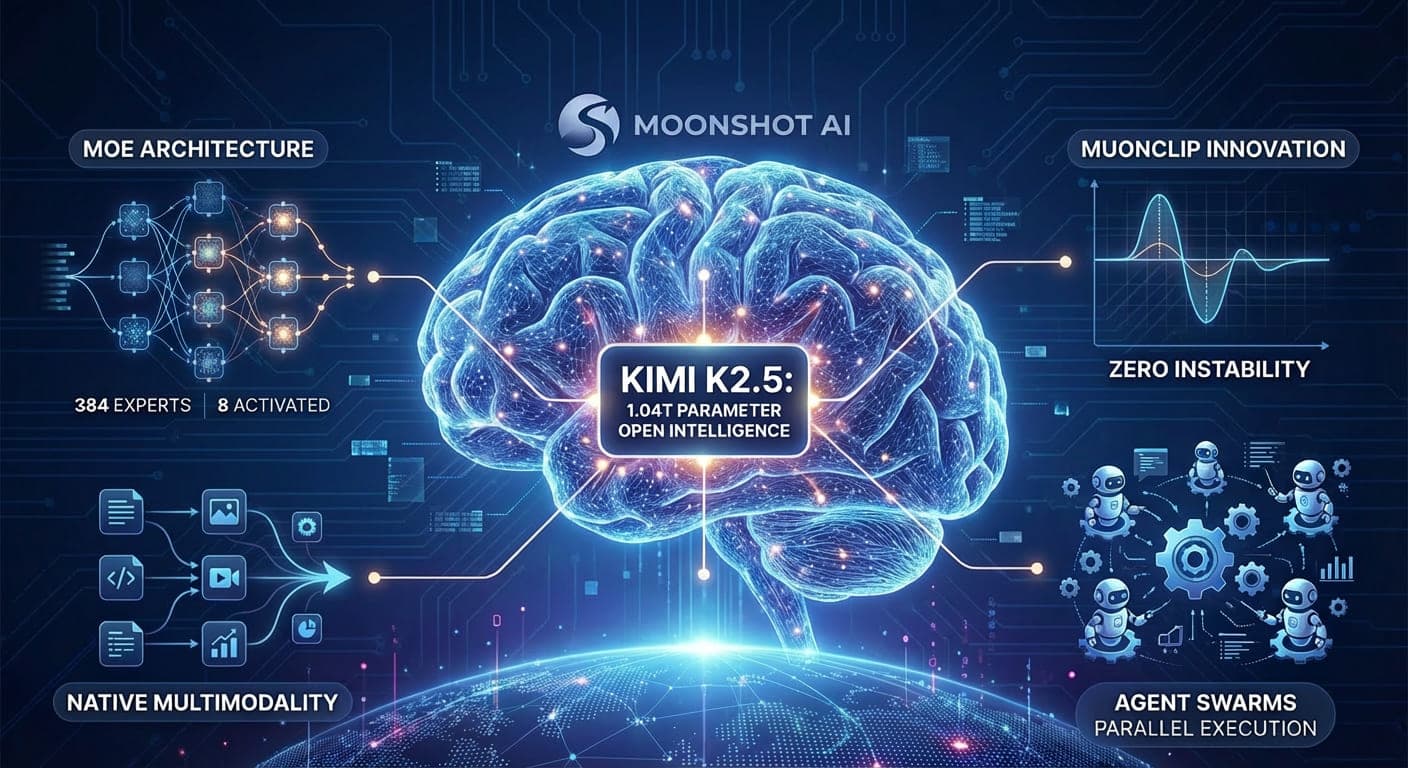
The release of Kimi K2.5 by Moonshot AI is a watershed moment for the global AI ecosystem. It represents the first time a model exceeding the one-trillion-parameter threshold, historically the exclusive domain of closed labs like OpenAI and Google, has been made available with open weights.
For enterprise leaders, this is not just a research milestone; it is a Sovereign AI opportunity. Kimi K2.5 combines the raw reasoning power of 1.04 trillion parameters with the operational efficiency of a sparse Mixture-of-Experts (MoE) architecture, allowing organizations to deploy frontier-level intelligence on private infrastructure without data leakage.
The structural foundation of Kimi K2.5 is a sparse Mixture-of-Experts transformer. In traditional “dense” models, every parameter is active for every token, leading to linear cost scaling. Kimi K2.5 breaks this rule.
By dividing its knowledge into 384 distinct expert sub-networks, the model activates only a fraction of its total capacity per token. A sophisticated “Router” selects the top-8 most relevant experts for each input, ensuring the model uses specialized neural pathways (e.g., coding experts for SQL, linguistic experts for translation).
To manage the massive Key-Value (KV) cache required for a 256,000-token context, Kimi K2.5 utilizes Multi-Head Latent Attention (MLA). Instead of storing the full KV matrices, MLA compresses attention inputs into a low-dimensional latent vector. This prevents the memory bottleneck that typically paralyzes trillion-parameter models during long-document analysis.
Training at the trillion-parameter scale is notoriously unstable. “Exploding attention scores,” where gradients vanish due to softmax saturation, often derail training runs.
Moonshot AI solved this with MuonClip, a novel optimizer that integrates the Muon algorithm with QK-Clip. Unlike traditional clipping that happens after calculation, QK-Clip operates at the weight level before instability arises. If the product of Query and Key matrices exceeds a threshold (typically ), it rescales the weights instantly.
This “Zero Instability” training run suggests that Kimi K2.5’s weights are exceptionally well-converged, making it a robust candidate for enterprise fine-tuning without the risk of “catastrophic forgetting.”
Unlike “modular” systems that bolt a vision encoder onto a text model, Kimi K2.5 is natively multimodal. Its MoonViT vision encoder (400M parameters) is trained jointly with the language backbone.
This allows for “Coding with Vision.” The model can ingest a video walkthrough of a website or a screenshot of a UI and generate functional, production-ready code to replicate it. It understands the temporal causal links in video and the spatial logic of documents.
For complex enterprise workflows, Kimi K2.5 introduces the “Agent Swarm.” Traditional agents suffer from “Serial Collapse”: they execute one step at a time, often getting stuck or timing out.
The Kimi Swarm utilizes Parallel-Agent Reinforcement Learning (PARL) to orchestrate up to 100 sub-agents simultaneously.
The Result: A 4.5x speedup in execution and an 80% reduction in end-to-end runtime.
The power of Kimi K2.5 lies in its open weights. However, hosting a trillion parameters requires strategy. Sterlites leverages Quantization-Aware Training (QAT) to deploy this model efficiently.
The “Modified MIT License” is free for research and most commercial use. Only massive entities (>100M MAU or >$20M/month revenue) face attribution requirements.
Kimi K2.5 proves that the trillion-parameter scale is no longer the monopoly of closed labs. It offers a blueprint for Open Agentic Intelligence: massive scale, native vision, and swarm orchestration.
For organizations seeking to build secure, autonomous digital workforces that reside within their own firewalls, Kimi K2.5 is the new standard.
Thinking about AI Research? Our team has helped 100+ companies turn AI insight into production reality.
Book a highly tactical 30-minute strategy session. We apply the engineering rigor developed with McKinsey, DHL, and Walmart to accelerate AI for startups and enterprises alike. Let's bypass the hype, evaluate your specific use case, and map a concrete path to production.
Establish your authority. Amplify these insights with your professional network.
Hand-picked insights to expand your understanding of the evolving AI landscape.