AI Research
NETFLIX VOID: Why AI Video Understands Gravity and Slays VFX Ghosts
5 APR2026
12 MINRead
---
Views Sterlites
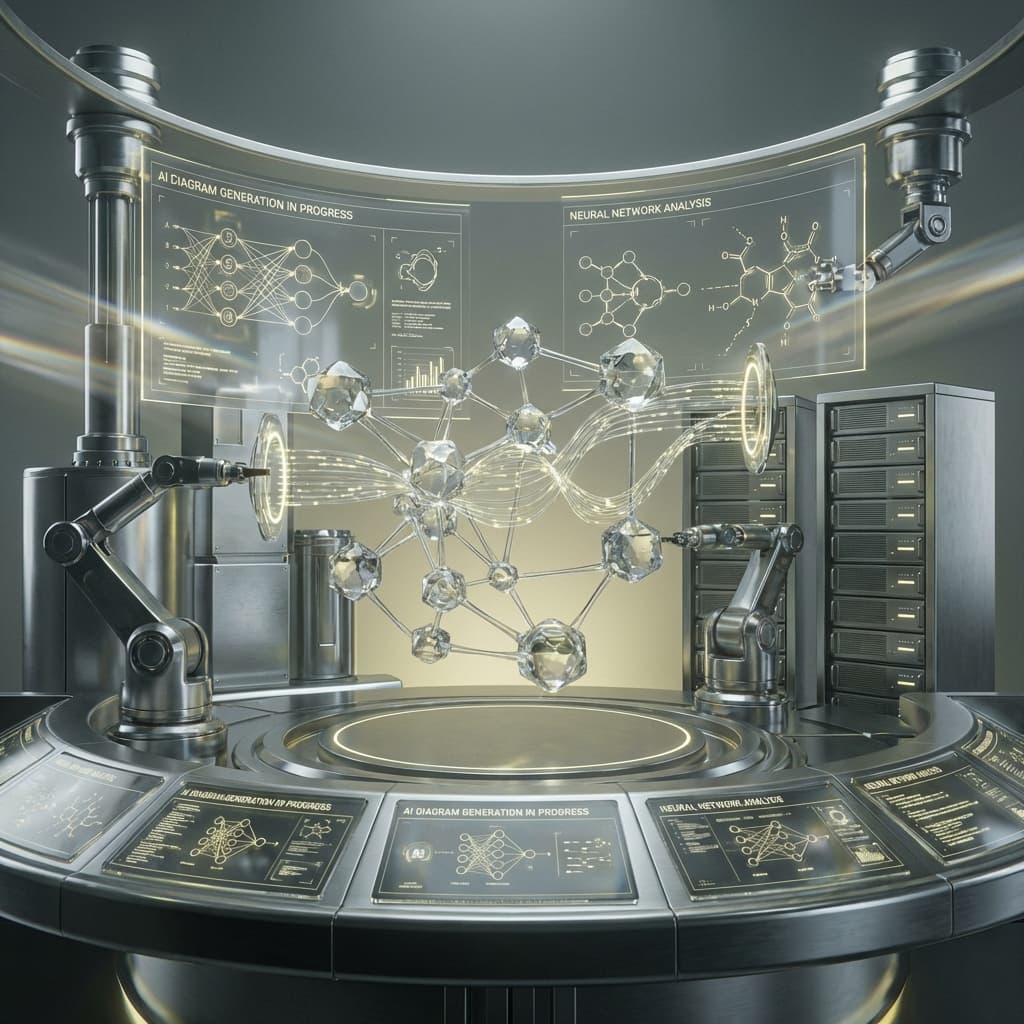
Humanity has automated the prose of science, but the picture remained a manual struggle, until now.
While Large Language Models (LLMs) have successfully automated the “thinking and writing” phases of the research lifecycle (from literature reviews to hypothesis generation), a critical Labor-Intensive Bottleneck persists in the visual communication of these ideas. Current autonomous AI scientists can draft an entire manuscript in minutes, yet they struggle to generate illustrations that adhere to the rigorous standards of top-tier academic venues.
This represents a crucial evolution in the architectures of autonomy, moving from text-based reasoning to multi-modal creation.
For researchers, the transition from a technical breakthrough to a high-fidelity methodology diagram remains a manual struggle. Legacy tools like TikZ, PowerPoint, or Python-PPTX require significant manual effort and often lack the expressiveness needed for the specialized icons and custom graph topologies common in modern AI publications. Scientists frequently find themselves spending hours on graphic design rather than core discovery, highlighting a clear gap in the path toward fully autonomous research.
Current autonomous AI scientists can draft an entire manuscript in minutes, yet they struggle to generate illustrations that adhere to the rigorous standards of top-tier academic venues.
PaperBanana is an Agentic Framework designed to bridge the gap between technical descriptions and professional-grade visuals. We formalize the task of automated academic illustration as learning a mapping from a source context and a communicative intent to a visual representation , optionally augmented by a set of reference examples :
The framework operates as a Reference-Driven, collaborative multi-agent system. It is powered by a hybrid stack: Gemini-3-Pro serves as the VLM judge and agentic backbone, while Nano-Banana-Pro functions as the specialized image generation model.
By leveraging an Agentic Workflow that incorporates Self-Critique, PaperBanana transforms raw methodology sections and figure captions into Publication-Ready assets.
PaperBanana orchestrates a specialized team to ensure every illustration meets scholarly standards for both content fidelity and visual aesthetics.
The workflow begins with “generative retrieval” from a dedicated reference set of 292 valid samples. Rather than matching by topic alone, the Retrieval Agent prioritizes:
By identifying references whose logical composition matches the user’s intent, the agent provides a concrete structural foundation for the downstream generation.
The Planning Agent acts as the cognitive core, translating raw data into a detailed textual description via in-context learning. This phase incorporates the Stylist Agent, which performs a high-impact feat: it traverses the entire reference collection to automatically synthesize a comprehensive Aesthetic Guideline .
Similar to how Neural World Models plan physical interactions, the Planning Agent constructs a visual strategy before pixels are rendered.
This guideline defines community standards for:
The Rendering Agent (or Visualizer) transforms the stylistically optimized description into visual output.
Generating code instead of pixels prevents “numerical hallucinations,” where bars or data points might be drawn at inaccurate heights relative to axis ticks. This ensures the mathematical precision required for data visualization.
To combat “visual hallucinations” and logical inconsistencies in graph topology, PaperBanana employs a Critic Agent in a closed-loop refinement mechanism.
The process involves T=3 rounds of feedback. The Review Agent inspects the generated image against the source context to identify factual misalignments or glitches, prompting the Rendering Agent to regenerate until the illustration meets high academic standards.
This self-critique loop is a prime example of the “Agentic Inflection,” where systems verify and correct their own outputs to ensure reliability.
To evaluate our framework, we introduced PaperBananaBench, a dataset comprising 584 valid samples (292 test cases and 292 reference cases) curated from NeurIPS 2025 publications. Using a VLM-as-a-Judge methodology (Gemini-3-Pro), we compared PaperBanana against leading baselines.
PaperBanana demonstrates significant improvements across all metrics, with a massive leap in Conciseness and Overall Score.
Performance varied by domain:
Our results indicate that while PaperBanana excels in aesthetics, fine-grained connectivity (such as specific arrow directions and source-target node matching) remains a frontier for current models.
PaperBanana acts as a critical bridge in the “Autonomous Research Lifecycle,” shifting the paradigm from AI that merely “thinks and writes” to AI that “visualizes and communicates.”
The current framework produces raster (PNG) images, which are inherently difficult to edit. The next frontier in this research involves the transition to vector graphics (SVG/AI) for “infinite scalability.” We envision the development of GUI Agents capable of autonomously operating professional design software like Adobe Illustrator. This would enable the production of fully editable, professional-grade vector illustrations with zero human intervention.
PaperBanana “democratizes access” to high-quality visual tools, enabling researchers to communicate complex discoveries without requiring specialized design expertise. By automating the most tedious aspects of figure creation, it accelerates the pace of scientific dissemination.
However, researchers must maintain rigorous human oversight. Users should view these agents as collaborators and remain vigilant against fine-grained “visual hallucinations” to ensure the absolute scientific integrity of every published illustration.
As models like Kimi k2.5 and frameworks like PaperBanana evolve, the toolkit for the autonomous scientist becomes exponentially more powerful.
Ready to integrate agentic workflows into your research or enterprise? Contact Sterlites Engineering to explore the future of autonomous systems.
Thinking about AI Research? Our team has helped 100+ companies turn AI insight into production reality.
Book a highly tactical 30-minute strategy session. We apply the engineering rigor developed with McKinsey, DHL, and Walmart to accelerate AI for startups and enterprises alike. Let's bypass the hype, evaluate your specific use case, and map a concrete path to production.
Establish your authority. Amplify these insights with your professional network.
Hand-picked insights to expand your understanding of the evolving AI landscape.