
Technology
JEPA vs LLMs: The Architecture War That Will Define the Next Decade of AI
22 APR2026
10 MINRead
---
Views Sterlites
Vision-based agents often fail not because they can’t see, but because their internal “imagination” collapses into a single, useless point. This instability is at the heart of the JEPA vs LLM architecture war. Relying on unstable predictive architectures forces engineers into a “hyperparameter hell,” where six or more variables must be perfectly tuned or the entire system becomes blind. You likely recognize the frustration of dealing with fragile Joint-Embedding Predictive Architectures (JEPAs) that require “stop-gradients” and “exponential moving averages” just to stay functional. The following analysis of LeWorldModel (LeWM) reveals how a simple two-term objective achieves stable, end-to-end training and 48x faster planning.
Representation collapse is the mathematical equivalent of an agent experiencing a total mental blackout while its sensors are still fully functional.
Imagine a robotic arm in a high-throughput sorting facility in Frankfurt that suddenly freezes. The system has fallen victim to “representation collapse,” where its internal world model perceives every distinct shipping container as the exact same latent pixel. This is the primary failure mode of Joint-Embedding Predictive Architectures (JEPAs) in production.
Think of representation collapse like a student who answers “C” to every multiple-choice question on an exam. They might “predict” correctly by pure chance a few times, but they haven’t actually learned anything about the material. In the context of world models, this means the agent can no longer distinguish between a clear path and a terminal collision because the encoder has found a mathematical “shortcut” to minimize loss without extracting features.
Existing models like PLDM attempt to solve this by stacking seven distinct loss terms, creating a nearly impossible scaling challenge. Research from Maes et al. (2025) suggests these methods rely on fragile heuristics like stop-gradients or pre-trained encoders to avoid manifold collapse. If seven terms can’t guarantee stability, the industry needs a simpler anchor.
Collapse occurs when an encoder maps every observation to a constant vector to trivially satisfy the prediction loss. Stability isn’t a feature: it’s the prerequisite for autonomy.
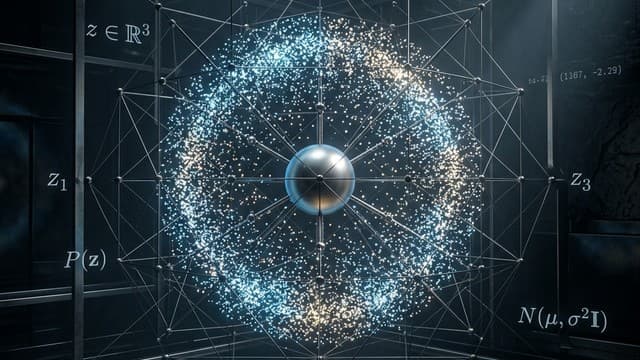
The secret to stable latent training lies in enforcing a statistical ‘guardrail’ that prevents data from clustering into a single point.
Contrast the Frankfurt failure with a system utilizing LeWorldModel, where the latent space remains diverse and structured despite environmental noise. LeWM utilizes the Sketched-Isotropic-Gaussian Regularizer (SIGReg) to enforce an isotropic Gaussian prior on the latent manifold.
Think of SIGReg like a well-hosted party where the host ensures guests are spread evenly across the room rather than huddled in a single corner. By projecting high-dimensional embeddings onto random univariate directions and applying the Epps-Pulley normality test, SIGReg ensures that the embeddings maintain the entropy necessary for meaningful dynamics prediction.
By reducing the objective to a simple two-term formula (Prediction Loss + SIGReg), engineers can abandon polynomial-time grid searches for logarithmic-time bisection. This architectural streamlining reduces R&D cycles from weeks to hours, allowing for predictable deployments in high-consequence Physical AI environments.
Real-time Model Predictive Control (MPC) requires extreme efficiency that bloated foundation models simply cannot provide.
In a precision assembly line, an agent must optimize its actions in “imagination space” before the next parts arrive on the belt. LeWM achieves planning speeds up to 48x faster than foundation-based alternatives like DINO-WM.
The structural cause of this speedup is a 15M-parameter ViT-tiny encoder that processes observations with 200x fewer tokens than heavy foundation models. Like the efficiency gains seen in recent small models, LeWM proves that size isn’t everything. Using a frozen 1B-parameter model for local robotic planning is like using a global satellite to find your car keys in your living room: it’s overkill that slows you down. LeWM acts as the high-speed local sensor that actually finishes the job in under 0.98 seconds.
This efficiency does not come at the cost of success. LeWM exhibits “temporal latent path straightening,” a phenomenon where the model’s internal trajectories become increasingly linear over time. This emergent property, usually seen in biological brains, allows the agent to navigate the latent space with minimal computational friction.
True ‘physical intuition’ is measured by a model’s surprise when the laws of nature are violated, not just its ability to match pixels.
During a “Violation-of-Expectation” (VoE) test, a block in a simulation is suddenly teleported to a random coordinate. While a standard pixel-matching model might simply re-index the scene, LeWM possesses an emergent physical intuition. Much like predictive physics in video generation, it assigns high “surprise” values (MSE) to physically implausible events like teleportation, even without explicit physics supervision.
The model is specifically sensitive to physical perturbations while remaining robustly indifferent to purely visual changes like an object changing color. This “surprise” metric serves as a vital safety trigger, detecting sensor malfunctions or environmental anomalies in industrial deployments.
In a warehouse setting, if a sensor gets obscured or a package falls unexpectedly, LeWM identifies the ‘impossibility’ of the trajectory before a collision occurs. This ‘physical surprise’ (calculated as MSE between predicted and actual embeddings) acts as an automatic safety override.
The industry’s current obsession with applying massive Foundation Models to every local control problem is a category error. True autonomy requires ‘lean’ world models that prioritize temporal dynamics and latent stability over static visual richness.
Concept: The Isotropic Guardrail.
Mechanism: Utilizing univariate projections (SIGReg) via the Epps-Pulley normality test to prevent latent clustering.
Implication: This creates a latent map where the model’s imagination is physically grounded but computationally light enough for sub-second planning.
The future of autonomous systems depends on “temporal latent path straightening”: making the model’s internal imagination as efficient as the physics it predicts. We are moving past the era of fragile hyperparameter tuning and toward stable, end-to-end JEPAs that “feel” the world.
Thinking about AI Research? Our team has helped 100+ companies turn AI insight into production reality.
Book a highly tactical 30-minute strategy session. We apply the engineering rigor developed with McKinsey, DHL, and Walmart to accelerate AI for startups and enterprises alike. Let's bypass the hype, evaluate your specific use case, and map a concrete path to production.
Establish your authority. Amplify these insights with your professional network.
Hand-picked insights to expand your understanding of the evolving AI landscape.